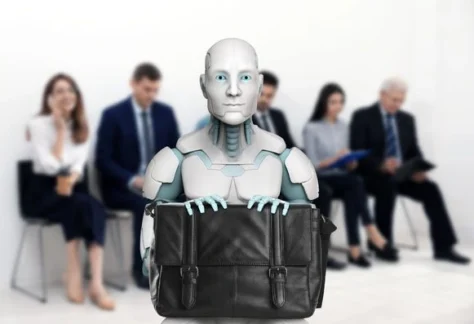
Imagine this: you’re an HR manager juggling dozens of open roles, flooded email inboxes of applicants, stacks of resumes to sift through, and endless rounds of interviews. It’s exhausting. Now imagine having an intelligent assistant that can help you screen candidates, simulate interviews, summarize conversations, and handle data — all while you focus on what really matters: connecting with people.
That’s not sci-fi. AI + ChatGPT can do this for modern HR teams — and OTC’s program, “AI in Simplifying HR Recruitment: Smarter Hiring with ChatGPT & Custom Tools,” shows you how to make it real.
Why AI in Recruitment? And Why Now?
The recruitment process has always been tedious, manual, and prone to human bias. Even with great effort, it’s hard to stay consistent, objective, and efficient when you’re dealing with high volumes of candidates.
AI changes the game:
- It helps trim down manual work — sifting through every CV, drafting interview questions, compiling notes, etc.
- It supports faster, more consistent candidate evaluation by applying the same filters and logic.
- It can free up HR teams to focus more on human judgment, empathy, and culture fit.
- And perhaps most importantly, done well, it can reduce biases and make the process fairer.
What You’ll Learn in the OTC Course (and Why It Matters)
Here’s a breakdown:
Day 1: Candidate Discovery & Screening
- AI in the Hiring Landscape – What AI can and cannot do, and how ChatGPT/custom GPTs fit into recruitment.
- Build a Custom GPT for Matching – Design a GPT that understands job descriptions, ideal skill sets, and sample CVs, so it can do the filtering work for you.
- Shortlist via ChatGPT – Plug in resumes or candidate data; craft prompts that filter by skills, experience, language, etc.
- AI Interview Assistant with Voice – Use voice-to-text tools, auto-generate interview questions, simulate voice interviews.
- Candidate Screening Simulation – In small groups, test your GPTs with candidate sets, decide who moves forward, and discuss human vs AI decisions.
Day 2: Automation, Interviewing & Reporting
- Automate Data Collection – Build application forms (e.g. Google Forms, Typeform), pipeline data to GPT for review.
- Interview Documentation via AI – Use AI to transcribe interviews, then have it create summaries, scorecards, evaluation reports.
- Responsible AI Use – Policies, data protection, bias mitigation, human-in-loop safeguards.
- Capstone Project – Simulate a full hiring cycle: create job ad, design GPT prompts, screen, interview, summarize, and present hiring recommendations.
By the end, you’ll have hands-on experience with custom GPTs, AI screening, voice interviews, data pipelines, and evaluation tools — all in a recruitment context.
How AI & ChatGPT Actually Simplify HR — From Theory to Practice
Putting the course aside for a moment, here are real-world ways AI and ChatGPT can simplify and supercharge HR recruitment:
HR Activity | Traditional Approach | AI / ChatGPT-enabled Approach |
Resume Screening | Manually review each CV one by one | Use custom GPT to filter high match candidates, rank them |
Candidate Shortlisting | HR spends hours comparing skills, experience | ChatGPT processes structured data to shortlist objectively |
Interview Question Design | HR crafts questions from scratch per role | GPT generates role-specific questions automatically |
Interview Execution | Interviews scheduled one by one, transcription done manually | AI voice systems simulate or assist interviews and transcribe |
Interview Notes & Reports | HR jots notes, compiles reports post meeting | AI summarizes transcripts, highlights strengths/weaknesses |
Data Collection | Collect candidate input manually or via static forms | Dynamic forms feed structured data straight to AI for review |
Bias & Consistency | Human biases may influence decisions, inconsistency in criteria | GPT applies uniform logic; human reviews final candidates |
These are not promises of replacing humans — but augmenting HR professionals so they can focus on judgement, candidate experience, culture fit, not tedious tasks.
The Human Element: Why HR Still Matters
Automating parts of recruitment does not mean removing people. In fact, the stronger your AI support, the more HR can shine in the human aspects:
- Building rapport with shortlisted candidates
- Assessing soft skills, culture fit, motivation, non-verbal cues
- Making final judgment calls — AI is a helper, not a decision-maker
- Ensuring fairness, transparency, empathy in the process
A smart AI + human partnership ensures speed, consistency, and humanity in hiring.
Potential Pitfalls & What to Watch Out For
AI is powerful — but without care, it can misfire. Here are some caveats:
- Bias in training data or prompts — if GPT is trained on biased inputs, it may replicate bias.
- Data privacy & consent — candidate information must remain secure, compliant with laws.
- Overreliance on AI — always include human review steps (human in the loop).
- Misaligned evaluation criteria — AI must reflect the correct metrics you value (skills, adaptability, values).
- Change management — HR teams need upskilling and mindset shifts to trust and use AI.
OTC’s program includes modules on responsible AI use, bias mitigation, and safeguards.
Why This Course is Worth Considering
If you’re in HR or hiring management, here’s what makes OTC’s AI in Recruitment course valuable:
- It’s hands-on: you’ll create, test, simulate — not just hear lectures
- No coding experience required — it’s accessible for HR professionals
- You’ll cover end-to-end hiring cycle — discovery, screening, interviewing, reporting.
- It explicitly addresses ethics, bias, and data privacy — essential for AI adoption in HR.
- You walk away with usable tools knowledge — GPTs, prompt design, automation flows you can use in your own work.
Getting Started — How You Can Begin Using AI in Recruitment (Today)
You don’t have to wait for formal training to experiment. Here are small steps you can try:
- Pilot a simple screening assistant
Use ChatGPT to help filter 20–30 resumes for a role, based on job criteria. - Generate interview questions with GPT
Input role details, desired competencies, and let GPT suggest structured questions. - Transcription + summarization
Record candidate interviews (with permission). Use transcription tools + GPT summarization for evaluation. - Prompt engineering practice
Practice refining prompts (“Filter candidates who have X years experience in Y, with skills A, B”) to improve output. - Start with human-in-the-loop
Always have HR review AI suggestions — treat the tool as an assistant, not the final judge. - Track outcomes carefully
Monitor how many shortlisted by AI are hired, turnover, and feedback — adjust accordingly.
Even modest experiments can reveal huge time savings and quality improvements.
Final Thoughts
AI and ChatGPT aren’t here to replace HR — they’re here to support it. When used thoughtfully, they can offload repetitive tasks, reduce bias, and make recruitment faster and more consistent.
But the human — you, the HR professional — remains central. Your judgment, empathy, values, and culture awareness are irreplaceable.
If you’re ready to step into AI-augmented HR, OTC’s “AI in Simplifying HR Recruitment” course is a strong stepping stone. You’ll gain not just knowledge but usable tools and experience.