Course Overview
GRI Awareness Training
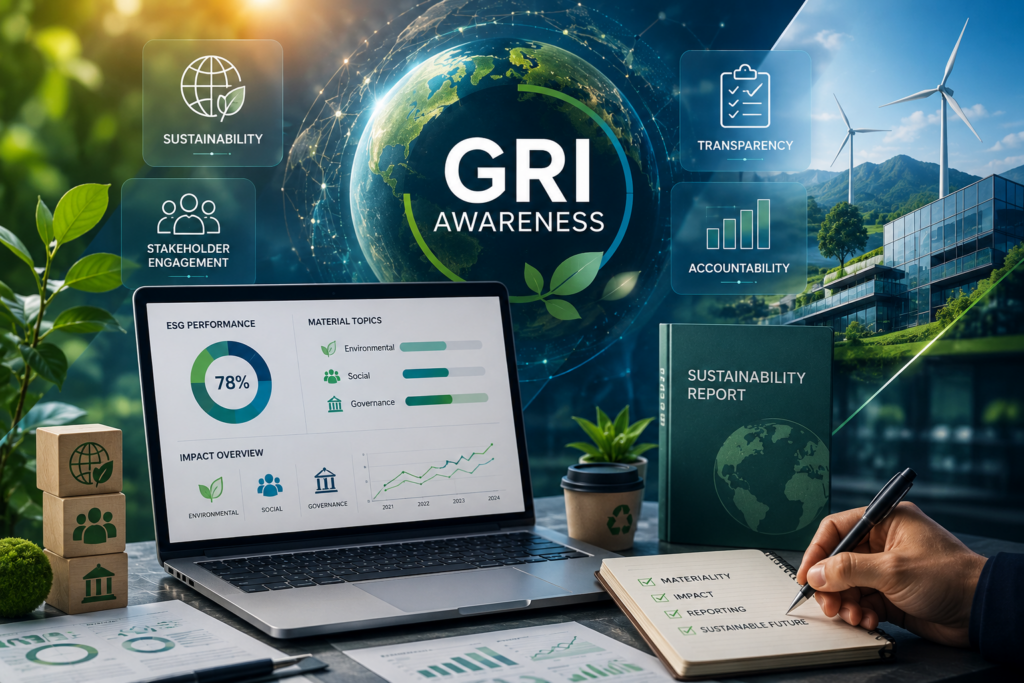
This one-day intensive GRI Awareness training program provides a comprehensive introduction to the Global Reporting Initiative (GRI) Standards, the world’s most widely used framework for sustainability reporting.
The program is designed to build foundational awareness of sustainability reporting, its business value, and the practical steps involved in preparing a GRI-aligned report.
Participants will move beyond theory to understand the core principles of materiality and stakeholder engagement, and gain the confidence to navigate the GRI Standards framework.
The training incorporates interactive discussions, sector-relevant examples, and a workshop to identify material topics, ensuring participants leave with actionable knowledge.
Course Objectives
By the end of this GRI Awareness program, participants will be able to:
- Understand the business drivers, challenges, and opportunities of sustainability reporting.
- Navigate the structure and application of the GRI Standards.
- Explain the principles of materiality and stakeholder engagement.
- Identify the key steps in preparing a sustainability report, from data collection to report writing.
- Apply the GRI Standards to identify material topics relevant to their organization.
Learning Outcomes
Upon successful completion of this GRI Awareness programme, participants will be able to:
- Understand the business drivers, challenges, and opportunities of sustainability reporting.
- Navigate the structure and application of the GRI Standards.
- Explain the principles of materiality and stakeholder engagement.
- Identify the key steps in preparing a sustainability report, from data collection to report writing.
- Apply the GRI Standards to identify material topics relevant to their organization.
Training Methodology
The GRI Awareness training employs a blended learning approach:
- Expert-led Presentations: To deliver core concepts and technical knowledge.
- Case Studies: To illustrate practical applications of GRI Standards in real-world scenarios based relevant similar organization.
- Interactive Workshops: To engage participants in applying the materiality concept.
- Group Discussions: To facilitate peer learning and share diverse perspectives.
Who Should Attend
This GRI Awareness course is ideal for professionals who are involved in or will be responsible for sustainability reporting, including:
- Senior management and business owners seeking to understand the strategic value of reporting.
- Sustainability, ESG, and CSR managers and team members.
- Corporate communications and investor relations professionals.
- Finance and risk management personnel involved in non-financial data collection.
Course Details
| Item | Details |
|---|---|
| Duration | 1 Day |
| Training Time | 9.00 AM – 5.00 PM |
| Training Method | Classroom / Instructor-Led Training |
| Delivery Method | Expert-led Presentations, Case Studies, Interactive Workshops & Group Discussions |
Course Content
Day 1 – Foundations of GRI and Sustainability Reporting
Welcome & Introductions
- Setting the context: The global sustainability landscape and reporting trends.
Module 1: The What and Why of Sustainability Reporting
- Introduction to sustainability and ESG principles.
- The business case for sustainability reporting: benefits for competitiveness, reputation, and stakeholder trust.
- Overview of the Global Reporting Initiative (GRI) and its multi-stakeholder approach.
Module 2: Structure and Application of the GRI Standards
- Understanding the structure of the GRI Standards: Universal Standards (GRI 101, 102, 103) and Topic-Specific Standards.
- How to use the GRI Standards for reporting “in accordance” or “with reference” to the framework.
- Comparing GRI with other key frameworks (e.g., ISSB, IFRS – NSRF).
Module 3: The Reporting Process – Materiality and Stakeholder Engagement
- The concept of materiality: identifying the most significant topics for the organization and its stakeholders.
- Stakeholder engagement: practical tips for identifying and engaging key stakeholder groups.
Workshop
- Participants will begin to identify material topics relevant to their industry, based on provided scenarios and examples.
Module 4: From Data to Disclosure
- Key steps in preparing a sustainability report: data collection, analysis, and report writing.
- Practical tips for reporting on material topics and managing boundaries.
- Action planning: outlining the initial steps for participants to apply GRI within their own organizations.
Q&A, Summary & Closing
- Q&A Session
- Programme Summary
- Closing Remarks