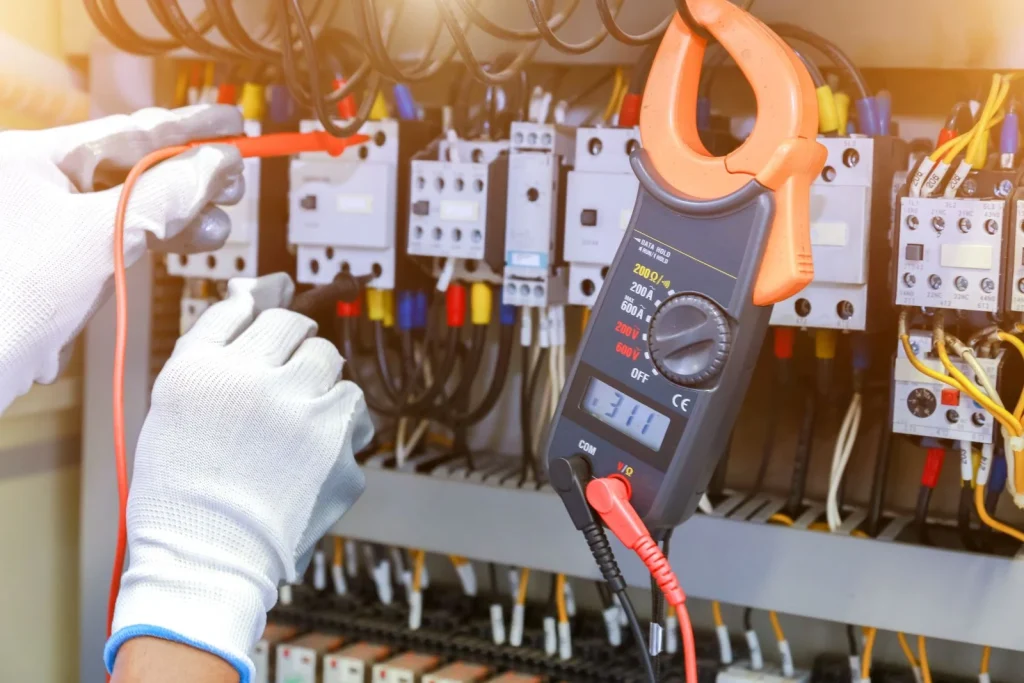
INTRODUCTION FOR MACHINERY 2014/35/EU – LOW VOLTAGE DIRECTIVES TRAINING
The aim of this 2 days Machinery Directive 2014/35/EU – Low Voltage Directives Training is to give machine manufacturers, modifiers, and those involved in pre-purchase auditing, an understanding of what is required to demonstrate compliance with the Low Voltage Directive (LVD 2014/35/EU), essential safety requirements for electrical equipment operating with a voltage of between 50 V and 1000 V for alternating current and 75V and 1500V for direct current.
COURSE OBJECTIVES
By the end of this training, participants will be able to:
- Know the fundamentals of Low Voltage Directives 2014/35/EU.
- Understand the Low Voltage Directives requirement of the European Community.
- Gain a good understanding of what is required to demonstrate compliance with the Machinery Directive 2014/35/EU for the European Market.
- Learn how to establish a design risk assessment (DRA) team and process for a new project.
- Improve the efficiency of market surveillance.
- Improve traceability of product origin.
- Clarify the respective obligations of manufactures, importers and distributors.
- Improve consistency between the different directives.
WHO SHOULD ATTEND
Engineers, Technicians, Supervisors, Designers, Project leads.
WORKSHOP METHODOLOGY
70% theory and 30% group activities and case studies.
TRAINING DURATION
2 Days (9am – 5pm). Maximum – 25 participants
COURSE CONTENT
Day 1 – 9.00am to 5.00pm
- Pre Test Assessment
- Introduction: Machinery Directive 2014/35/EU – Low Voltage Directives
- Introduction to the Low Voltage Directive
- Covers all electrical equipment and components.
- Designed for use with a voltage rating of between 50 and 1000 V for alternating current.
- Designed for use between 75 and 1500 V for direct current.
- The Low Voltage Directive defines which products fall within its field of application
- Provides the essential (safety) requirements that electrical equipment and components.
- Comply with, and it outlines the conformity assessment procedure.
- Manufacturer must apply in order to ensure compliance with the essential requirements.
- Which products are covered by the scope of Directive 2014/35/EU?
- Which products are not covered by the Directive?
- How to comply with the Low Voltage Directive?
- Do you need help with CE marking according to the Low Voltage Directive?
- Other articles that may be of interest
- Which products are covered by the scope of Directive 2014/35/EU?
- The term “electrical equipment” is not defined in the Directive.
- “Item used for such purposes as generation, conversion, transmission, distribution or utilisation of electrical energy
- Machines, transformers, switchgear and control gear, measuring instruments, protective devices, wiring material, current-using equipment.”
- The scope of the Directive includes both electrical equipment intended for incorporation into other equipment.
- Equipment intended to be used directly without being incorporated.
- Electrical equipment – Designed for use with a voltage rating of between 50 and 1000 V for AC
- Between 75 and 1500 V for direct current (DC).
- Voltage ratings refer to the voltage of the electrical input or output
- Not to voltages that may appear inside the equipment.
- Examples of products within the scope of the LVD Directive:
- Socket outlets 230 V for domestic use.
- Luminaire plugs and socket outlets for domestic use.
- Appliance couplers –plugs, -outlets.
- Appliance couplers for industrial purposes.
- Appliance couplers e.g. vehicle heater i.e. manufacturer fabricated standars.
- Cord extension sets Plug + cable + socket outlet with or without passive components.
- Cord sets and interconnection cord sets Plug + cable + cord set.
- Installations enclosures and conduits.
- Multiple travel adaptors.
- Multiple travel adaptors with supply (e.g. charger for mobile phones or music player).
- Plug with one or more socket outlets with incorporated electronic dimmer or twilight dimmer.
- Product with integrated plug and/or outlets. 230V for domestic use (e.g. charger for mobile phones, night lights).
- Switches for households and similar fixed electrical installations.
- Voltage detectors.
- Earthing and Grounding
- Which products are not covered by the Directive?
- Specialised electrical equipment, for use on ships, aircraft or railways, which complies with the safety provisions drawn up by international bodies in which the Member States participate.
- Electrical equipment for use in an explosive atmosphere.
- Electrical equipment for radiology and medical purposes.
- Electrical parts for goods and passenger lifts.
- Electricity meters.
- Plugs and socket-outlets for domestic use.
- Electric fence controllers.
- Radio-electrical interference.
- How to comply with the Low Voltage Directive?
- The responsibility to perform conformity assessment is on the manufacturer
- The manufacturer performs the conformity assessment and documents the assessment in his own right.
- Typically, the conformity assessment entails visual inspections and tests in accordance with European harmonized standards.
- Where the manufacturer is not able or willing to do the assessments himself, he may involve thirds party bodies.
- There are no special requirements for these bodies.
- The manufacturer may want to ensure the body has competence regarding the tests and assessments it conducts.
- Safety Objectives of LVD
- To provide information on the product or its accompanying documentation to enable it to be used safely for it intended purposes.
- The equipment and its parts shall be made in a way that it can be properly assembled and connected
- Design of equipment is to protect against:
- Physical harm to people and domestic animals
- High temperatures
- Electrical arcs or Radiation are not produced
- People, Domestic animals
- Property protected against non-electrical dangers
- Insulation breakdowns
- The equipment should meet mechanical requirements so as not to cause a danger to people, domestic animals and property
- The equipment should meet mechanical requirements so as not to cause a danger to people, domestic animals and property in the foreseeable overload condition
Day 2: 9.00am to 5.00pm
- Low Voltage Directives – Hazards Evaluation – Line Visit
- Hazards – Aspects and Impacts
- Risk Assessment
- Risk Severity
- Prevention
- Substitute
- Controls
- PPEs
- Mains Power Distribution Panel
- Design
- Safety devises
- Circuit breakers
- Circuit isolators
- Fuses
- Test Tools and Instruments
- Machine Parts Breakdown and Common Failures
- Parts operated with Low Voltages
- Input – Process – Output
- Motors – Single and Three phases
- Common electrical failures and defects
- Hazards evaluation – Aspects and Impacts
- Cause and Effect Diagram
- Machinery Risk Assessment –Identifying and Applying LVD
- The Machinery Directive EHSRs
- Responsibilities
- Mechanical and electrical risk assessment and safety requirement
- Practical risk assessments – Prevention, Substitute, Controls and PPEs
- Certification requirements
- Identifying and applying standards
- Zoning and ignition hazard assessment
- Dusts and vapours
- Noise pollution
- Vibrations
- GHG emission
- Requirements for electrical and mechanical equipment
- Notified Body Certification
- DSEAR
- Electrical Equipment Safety
- Electrical safety and EMC
- Low Voltage Directive
- Radio Equipment Directive
- Identifying and applying standards
- Testing and assessment
- Technical documentation, declarations and certificates
- Buying Machinery – Safety Compliance
- Low Voltage Directives – LVD
- Machinery specifications
- Supplier questions – Checklist
- Documentation
- Dealing with partly completed machinery and components
- In-service obligations
- Modifications
- Provision and Use of Work Equipment Regulations (PUWER)
- CE Certification – CE Marking – Low Voltage Directive
- Low Voltage Directive (LVD) safety testing
- Product is unsafe – Pose a potentially very serious risk to health.
- Possibility of fire or explosion should a product be electrically unsafe.
- 5 ways to fail Low Voltage Directive (LVD) testing
- Single fault testing
- Temperature rise
- Protection of batteries (in particular lithium cells)
- Component approval
- Marking and Labeling instructions
- Conclusion
- Training summary
- Post Test
- Q and A session
- Training Evaluation