Course Overview
Equipment Validation For Medical Device (IQ, OQ, PQ)
“Quality is generally transparent when present, but easily recognized in its absence.” -Alan Gillies-
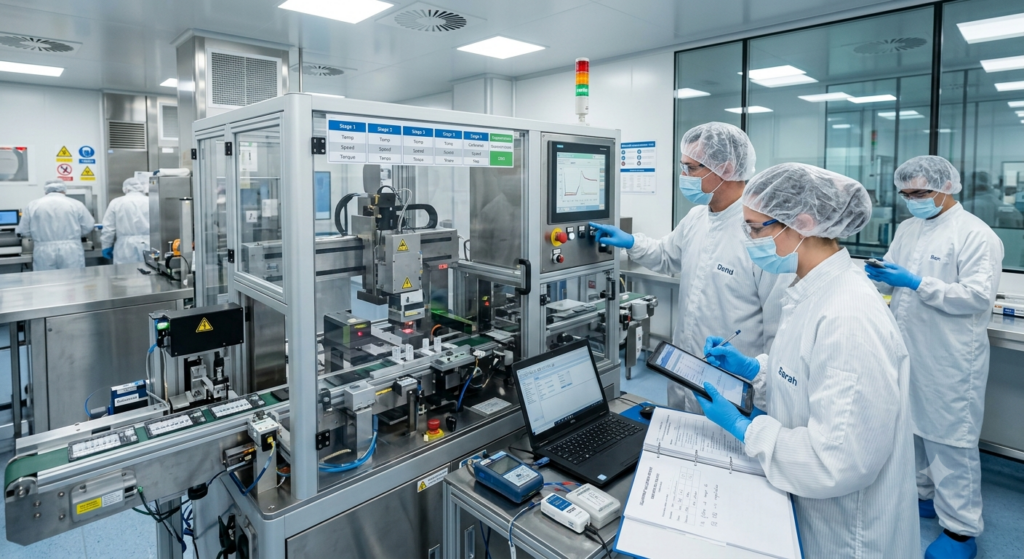
Equipment validation is the documented process of confirming that manufacturing machinery, instruments, and systems consistently operate to specifications, performing intended functions reliably and safely. Vital in regulated sectors, it ensures correct installation (IQ), expected operation (OQ), and consistent production performance (PQ) to prevent defects, ensure compliance, and maintain high quality and safety.
How You Will Benefit
Making sure that you have objective evidence that user needs and intended uses are met.
Increased usability and reliability, decreased failure rate and recalls, and reduced risks to patients and users.
Course Objectives
Familiarize with the latest FDA guidelines and interpretations of product/process validation.
Recognize how Validation Master Plans help the planning process.
Differentiate between qualification, verification, and validation.
Identify if (and when) validations are required.
Determine what activities must be completed prior to conducting a validation (confirming) event.
Learn how to conduct and document a validation event.
Understand what to do when things go wrong (What if’s!).
Use peer feedback to learn about your own planned or completed validation programs including specific issues and questions.
Who Should Attend
Quality managers, quality engineers, and quality technicians involved in the development and manufacturing of medical devices. Professionals directly involved in meeting the FDA’s quality system requirements such as those in regulatory affairs, quality assurance, process development, or manufacturing.
Our Solutions
This course can be run in-company around the world.
We can tailor the content to focus on your requirements.
This approach makes perfect sense for groups of 4+ delegates, enhancing cost-effectiveness as well as team bonding.
Classroom accompanied by Lectures, real Experience Sharing, Role-plays, Interactive Group Activities, Experiences, Simulation Activities, and Feedback.
Delegate manuals and certificates of Attendance will be provided.
Course Content
1. Introduction to Validation and Regulatory Requirements
Concepts: Definition of equipment validation and qualification.
Regulations: Overview of FDA 21 CFR 820.70(g) (medical devices).
Quality Standards: ISO 13485:2016 requirements.
The Validation Lifecycle: Introduction to the V-model for validation.
2. Validation Planning and Documentation
Validation Master Plan (VMP): Scope, approach, and resources.
User Requirement Specifications (URS): Defining required functions, capacities, and safety features.
Risk Management: Using Risk Assessment (e.g., FMEA) to define critical parameters.
3. Design Qualification (DQ)
Verifying that the proposed design is suitable for the intended purpose.
Vendor assessment and design review.
4. Installation Qualification (IQ)
Installation Verification: Ensuring equipment is delivered and installed correctly per manufacturer instructions.
Documentation Checks: Manuals, drawings, and spare parts lists.
Utility & Site Check: Proper location, utilities (water, power), and environmental conditions.
Calibration: Verifying instruments are calibrated before use.
5. Operational Qualification (OQ)
Functional Testing: Testing operating ranges (speed, temperature, pressure).
Control Systems: Verifying software, alarms, and emergency stops.
Standard Operating Procedures (SOPs): Training on, drafting, and approving operational SOPs.
Process Limits: Determining upper and lower operating limits.
6. Performance Qualification (PQ)
Consistent Performance: Proving the equipment works consistently under normal load and operating conditions.
Long-term Stability: Ensuring the process remains in a state of control.
7. Deviation Management and Final Reporting
Deviations: Documenting, investigating, and resolving issues during testing.
Final Report: Summarizing results and providing a recommendation for use.
8. Revalidation and Maintenance
Change Control: Managing modifications post-validation.
Periodic Review: Scheduling revalidation.
9. Specialized Topics
Cleaning Validation: Ensuring equipment can be properly cleaned.
Computerized System Validation (CSV): Validating software and PLC systems.