Course Overview
8051 microcontroller is equipped with many built-in resources such as timers, interrupts and supports serial communication. It comes in many different variants ranging from the low-range, mid-range to the high-end range. This training will cover in-depth on the concepts and fundamentals of 8051 microcontroller and assemble language programming through a series of lectures and lab sessions. First, the basic introduction to the microcontrollers and microprocessors and their differences will be covered. Then, a general overview on the components that make up a microcontroller will be discussed. This is followed by a detailed coverage on the architecture of the 8051 microcontroller, including the pin assignment, input-output, register banks, general purpose register and special function registers, internal and external memory, memory map and buses. Then, the training progresses to cover the constructs of the assembly language programming, and the instruction set. Finally, the course will cover the C language programming. Suitable examples will be provided to enhance the understanding of the programming language. In the lab sessions, participants will learn how to write assembly/C code and learn to program the code an 8051 microcontroller.
The Workshops will help you to:
- Familiarise with the development in microcontroller technology
- Familiarise with the Intel 8051 microcontroller
- Understand the architecture and peripherals of the Intel 8051 microcontroller
- Understand the input/output, interrupts and timers of the Intel 8051 microcontroller
- Write assembly code to program the Intel 8051 microcontroller
Who Should Attend
This course is suitable for design engineers in electronics/embedded design, and those from academia.
Methodology
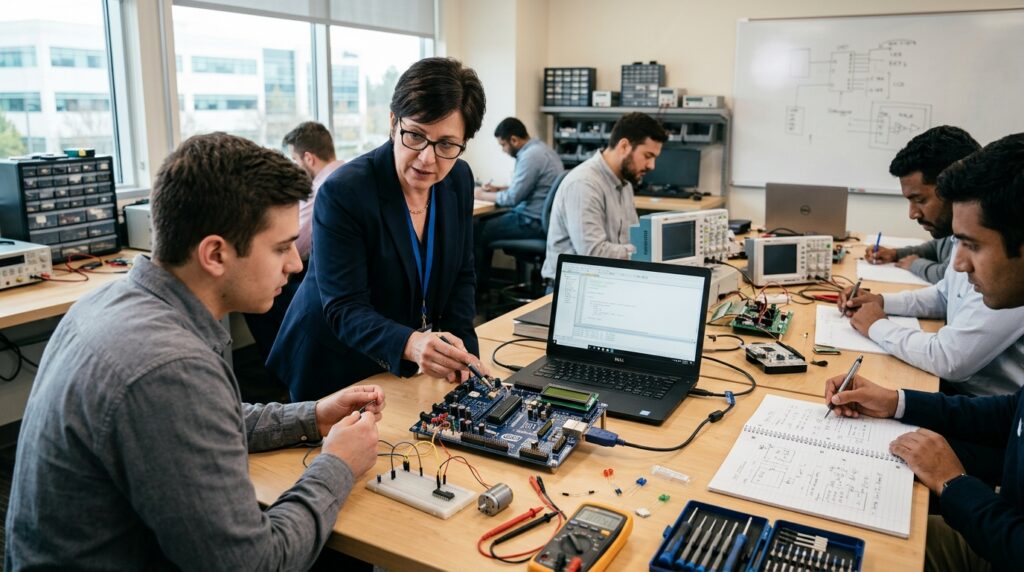
Seminar consists of 2 days’ training workshops. The course will be delivered through a mixture of classroom lectures and hands-on laboratory exercises. The training can be delivered on-site, online or hybrid.
Course Content
Day 1:
Module 1 – An Overview of Microcontrollers
Introduction to microcomputer, microcontrollers, evolution of microprocessors, applications, microcomputer organization, bussed architecture
Module 2 – Microcontroller Architecture
Internal architecture, pin configuration, states, operation modes and registers, addressing mode, characteristics of memory, access time, classification.
Hands-on laboratory
Day 2
Module 3 – Programming
Instruction set, addressing modes, instruction encoding, assembly language programming
Module 4 – Input/Output and Device Interfacing Techniques
Interfacing I/O devices, I/O address decoding, interrupt, timer, serial/parallel communication
Hands-on laboratory