Course Overview
High Voltage Training
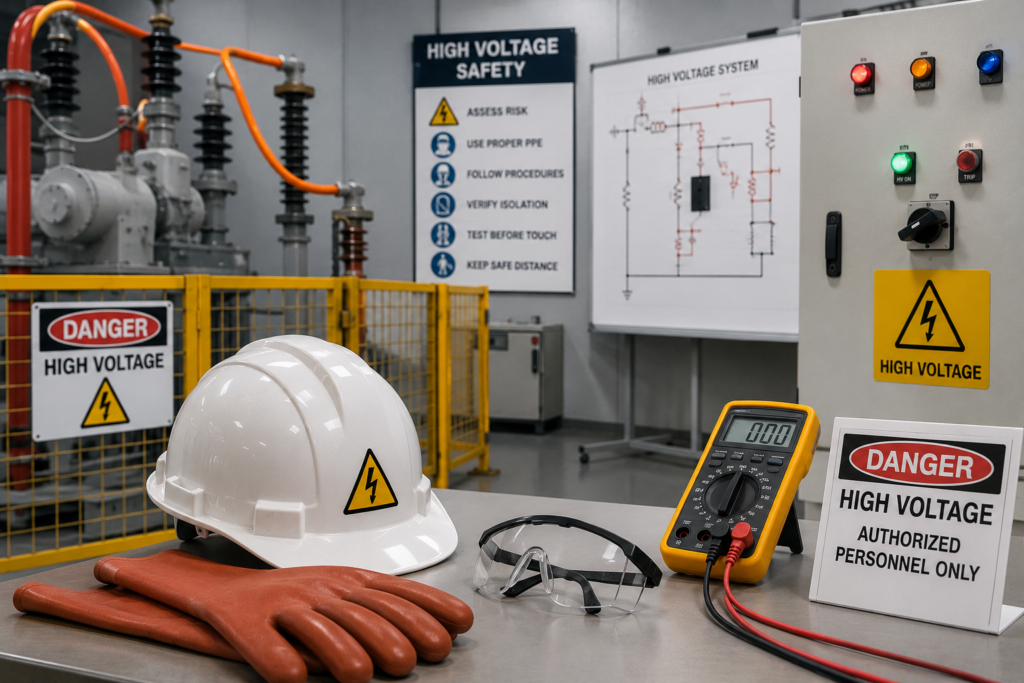
A 2-day High Voltage (HV) Qualified Works training program is designed to equip electricians, technicians, and engineers with the knowledge to safely work on or near high-voltage systems (typically >1000V AC or >1500V DC). The training focuses on identifying hazards, risk assessment mitigations, safe isolation techniques, and compliance with regulations such as OSHA 1910.269 or NFPA70E.
Course Objectives
To enhance knowledge and skills in the following areas:
Understand NFPA70E – Workplace injuries and fatalities due to shock, electrocution.
Understand about high voltages and their hazards.
Able to conduct Hazard Evaluation when handling high voltages and their electric circuits.
Know about Arc flash and, arc blast safety – PPEs and emergency safety responses.
Able to assist in complying with OSHA 1910 Subpart S and OSHA 1926 Subpart K.
To enable participants to act as a “Qualified Person” authorized to perform electrical isolation and electrical safety during maintenance, troubleshooting and repairs.
Prerequisites
Participants require a basic electrical certificate or equivalent experience.
Who Should Attend
HV Electrical Technicians, HV Engineers, Chargeman, Facility Technicians, Preventive Maintenance Engineers and Technicians.
Methodology
The course will be delivered through a combination of lectures and assignments with sharing session including group discussion and presentations. Practical in LOTO application shall be used as hands on skill practice at shop floor. Case studies plus selected video shows shall enhance learning outcome.
Course Content
Day 1: 9.00am to 5.00pm – High Voltage, Workplace Application and Safety
Pre Test – High Voltages KSA Assessment
Exercise 1: What is high voltage? Explain how this HV is utilized in your process and production? What is UPS? Why use UPS?
Module 1: High Voltage Fundamentals and Hazards
Introduction to High Voltage and Workplace Application and Safety
HV Theory and Regulatory Compliance
HV system components (switchgear, transformers, cables).
Hazards: Electric shock, arc flash/blast, thermal burns.
Effects of electricity on the human body.
Exercise 2: Discuss and share how TNB supply is processed and utilized into your production processes, buildings and how it is removed from hazards before using as your power distribution at shop floor?
Module 2: Regulatory Standards and Safety Management
OSHA 1910.269 and NFPA70E requirements.
Definition of a “Qualified Person”.
Safe approach distances and boundary control.
Exercise 3: What are the responsibilities of a Qualified Person in handling High Voltages
Module 3: Risk Assessment and Control
Hierarchy of Controls (elimination, engineering, PPE).
Job Safety Analysis (JSA) and Method Statements.
Exercise 4: List down all hazards and risks associated with HV in your power distribution to production and other utilities.
Module 4: Personal Protective Equipment (PPE) and Tools
Selection and inspection of voltage-rated gloves, arc-rated clothing.
Safe use of live-line tools and testing equipment.
Exercise 5: Why Human safety is very important? What are the risks exposed and how your organization take precautions?
Day 2: 9.00am to 5.00pm – Practical Application, Switching, and Assessment
Day 1 Lessons Recap: Quiz / Assessment on theoretical knowledge.
Module 5: The “5 Golden Rules” for Safe Isolation
Disconnecting completely, securing against reconnection, verifying de-energized state, grounding, and protecting against adjacent live parts.
Exercise 6: What are the safety measures one has to comply with when de-energize and isolate HV power supply from your Machineries?
Module 6: Switching Operations and Procedures
Permit-to-work systems and isolation control certificates.
Switching procedures for HV breakers and switchgear.
Exercise 7: HV Engineering drawings and circuit symbols. What are they, name them. Is Earthing and Grounding same or they are different? Explain.
Module 7: Hands-On Practical Training
Demonstration of proving dead (absence of voltage).
Application of safety grounds (earthing).
Simulation of switching operations in a workshop environment.
Exercise 8: Application of LOTO and Visual Safety Management
Module 8: Emergency Response and Assessment
Rescue procedures from live HV equipment.
ERT: First Aid, Fire Fighting and Chemical Spill Containment
Fire Fighting Equipment: Hydrant, Hose Reels, Fire Extinguishers, Sprinkler System, Smoke Detector, Fire Alarm System, Emergency Doors and Others.
Employee Training:
Pre OJT Training
OJT Training
Certifications
ER Training
Exercise 9: How does your Safety and ERT team conduct, and collaborate Fire Evacuation Drill in your company? Is your fire evacuation drill successful? Do explain the drill flow and objectives?
Module 9: Conclusion
Training Summary
Post Test Assessment
Training Evaluation
Course Administration & Details
Training Duration: 2 full days (9am – 5pm)
Maximum participants per class: 24 persons.