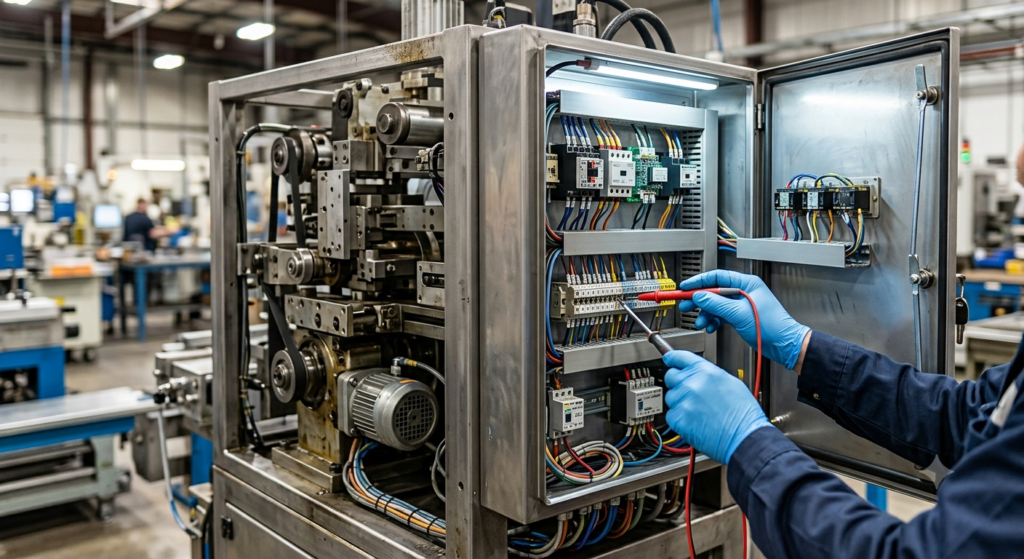
Course Overview
Electro-Mechanical Preventive Maintenance is designed to provide participants with the essential knowledge and practical skills required to maintain electrical and mechanical equipment effectively. Modern industries rely heavily on electro-mechanical systems to support production, operations, and facility management. Unexpected equipment failures can result in costly downtime, production losses, safety hazards, and increased maintenance expenses.
This comprehensive two-day training program focuses on preventive maintenance techniques that help organizations reduce equipment breakdowns, improve reliability, and extend asset lifespan. Participants will gain a clear understanding of both electrical and mechanical systems, including their components, functions, common failure modes, and maintenance requirements.
Who Should Attend
This electro-mechanical program is suitable for:
- Maintenance Technicians
- Maintenance Engineers
- Production Technicians
- Production Supervisors
- Machine Operators
- Facility Maintenance Personnel
- Service Technicians
- Engineering Assistants
- Reliability and Asset Management Personnel
- Individuals responsible for maintaining electro-mechanical systems
No advanced engineering background is required, making this program suitable for both new and experienced maintenance personnel seeking to strengthen their preventive maintenance capabilities.
Training Outcomes
- Apply preventive maintenance principles to electrical and mechanical systems.
- Conduct inspections, cleaning, lubrication, and minor repairs effectively.
- Detect and troubleshoot common faults in electro-mechanical equipment.
- Maintain proper maintenance records and schedules.
Learning Benefits
- Reduced equipment downtime and maintenance costs.
- Enhanced workplace safety and operational efficiency.
- Practical skill development and improved employability.
- Better planning and preventive maintenance decision-making
Course Content
| Day / Time | Session / Topic | Learning Outcomes | Learning Benefits |
| Day 1 | |||
| 08:30 – 09:30 | Introduction to Preventive Maintenance | Understand preventive maintenance principles and types; identify differences between reactive, preventive, and predictive maintenance | Safer working practices; reduced emergency breakdowns Workshop theory practical |
| 09:30 – 11:30 | Electrical Systems Overview | Identify electrical components (motors, relays, switches, sensors); read basic wiring diagrams; perform simple measurements | Early detection of electrical issues; improved safety and efficiency Components will be used to build a simple project |
| 11:30 – 12:30 | Preventive Maintenance of Electrical Components | Conduct inspections on motors, contactors, circuit breakers, fuses, and wiring; perform cleaning and lubrication; maintain maintenance logs | Prolong equipment life; reduce repair costs Components will be used to build a simple project |
| 12:30 – 13:30 | Lunch Break | ||
| 13:30 – 16:30 | Practical Exercises: Electrical Maintenance | Apply preventive maintenance procedures; use tools such as multimeter and insulation tester; record maintenance activities | Hands-on experience; confidence in performing electrical maintenance; better retention of skills Carryout test on electrical |
| Day 2 | |||
| 08:30 – 10:00 | Mechanical Systems Overview | Identify mechanical components (bearings, belts, gears, pumps); understand lubrication types and schedules; monitor vibration and noise | Prevent mechanical failures; extend equipment lifespan Mechanical components will be used.ie bearing etc |
| 10:00 – 12:00 | Preventive Maintenance of Mechanical Components | Conduct inspections on belts, pulleys, bearings, and gears; perform alignment and tensioning; apply proper lubrication | Minimize mechanical breakdowns; improve operational efficiency Inspection test on wear & tear |
| 12:00 – 13:00 | Lunch Break | ||
| 13:00 – 15:00 | Troubleshooting Electro-Mechanical Systems | Apply combined electrical and mechanical knowledge to diagnose faults; perform root cause analysis; understand corrective actions | Faster problem resolution; reduced downtime; improved decision-making 8 D corrective action workshop |
| 15:00 – 17:30 | Practical Exercises: Integrated Maintenance & Troubleshooting | Hands-on preventive maintenance of a motor-pump system; simulate faults; perform troubleshooting; complete maintenance documentation | Real-world practice; confidence in integrated maintenance; improved reporting skills Simulation and discussion |