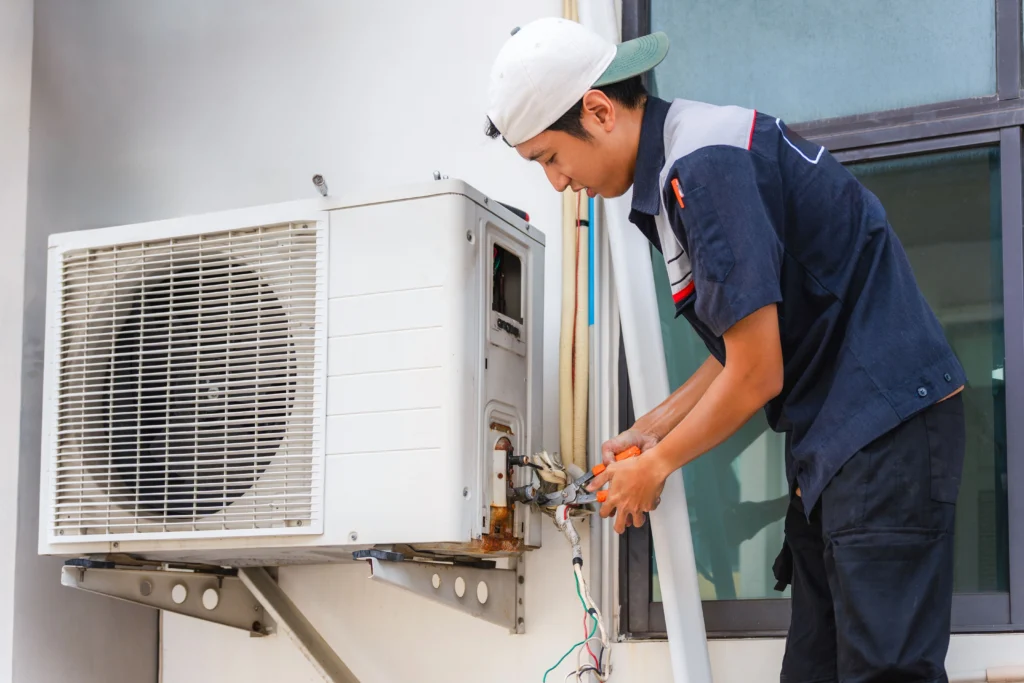
INTRODUCTION FOR AIR-COOLED SPLIT UNIT AIR-CONDITIONERS (ACSU)-DAIKIN & YORK
A split air conditioner consists of two main parts: the outdoor unit and the indoor unit. The outdoor unit is installed on or near the wall outside of the room or space that you wish to cool. The unit houses the compressor, condenser coil and the expansion coil or capillary tubing. The sleek-looking indoor unit contains the cooling coil, a long blower and an air filter. A split air conditioner does not require major installation work because it does not require ductwork. Rather, the indoor and outdoor units are connected with a set of electrical wires and tubing. This kind of air conditioner system has many advantages over traditional air conditioners. Perhaps the most obvious benefit is the quiet performance of a split air conditioner system. The parts of an air conditioner that make the most noise are the compressor and the fan that cools the condenser. In a split system, the compressor and fan for the condenser are located outside of the room being cooled and therefore the major sources of noise are removed – unlike with window units.
Another benefit of a split air conditioner system is that you can opt for a multi-split system, where you can have more than one indoor unit connected to a single outdoor unit. This makes it easy to cool multiple rooms or maintain the temperature throughout a large room through the use of two indoor cooling units.
A split air conditioner is an efficient and cost-effective way to cool. It should be noted that the initial cost of this kind of air conditioning unit is significantly higher than a window unit and it does require professional installation. However, the amount of money you will save on your energy bills as well as the longevity of the unit will make it worth your while in the end.
LEARNING OBJECTIVES
- To understand the Refrigeration Cycle of the Split Air Conditioner;
- To understand the Operating Principles of Refrigeration Components of a Split Air Conditioner;
- To present the care, technical and Safety Information on Refrigerants;
- To understand the difference between R22 & R410a;
- To understand the Reasons for Evacuation;
- To understand the Factors Affecting Evacuation;
- To understand the Correct Evacuation Procedures;
- To understand the Operating Principles of Single Phase Electric Motors Installed in a Typical Split Air-conditioner;
- To understand & Interpret the Schematic Wiring of a Split Air-conditioner;
- To Provide Guidelines for Good Service Practices;
- To Provide Guidelines for Quality Installation of Split Air Conditioners;
- To Demonstrate the Correct Procedures for Minor and Major Service of a Split Air-conditioner;
LEARNING OUTCOMES
At the end of the programme, participants will be able to:-
- develop a working knowledge of ACSU Systems ;
- differentiate between the different types of ACSU Systems;
- Implement strategies and methodologies to create an effective ACSU maintenance programme;
- improve performance by developing detailed ACSU specifications;
- establish an effective ACS maintenance team.
WHO SHOULD ATTEND
Project Managers / Engineers, Design Managers / Engineers, Engineers, Facility Managers / Engineers, Facility Supervisors, Property/Asset Managers, Plant Engineers, Maintenance Engineers, Process Engineers etc.
COURSE CONTENTS
DAY 1
Air Conditioning Fundamentals
- Air-conditioning fundamentals;
- Review of Split Air-conditioner Catalogues;
- Energy Efficiency Labelling Standards;
- Working principle of the major components of a Split Air-conditioner.
Refrigeration System Components of Split Air Conditioners
- Rotary Compressors- fixed and variable speed;
- Condenser;
- Evaporator;
- Expansion devices;
- Accessories;
Refrigeration & Refrigeration Oil Handling
- Refrigerant Chemistry;
- Ozone Depletion, Montreal Protocol & Global Warming;
- Technical Considerations on Single Compound HCFC & Blend HFC Refrigerants
- Refrigerant Safety;
- MSDS on Refrigerants- R22, R134a, R407c, R410a & R404a;
- Refrigeration Oil Properties;
- Mineral & Synthetic Oils;
- MSDS on Refrigeration Oil ;
- Acid Test Kit;
- Oil Analysis Result Interpretation.
Evacuation Procedures
- Describes the damage occurring in an air conditioning system due to contamination
- Describe the factors which affect evacuation
- Select the proper vacuum pump for a particular system
- Describe the correct method for connecting and disconnecting a vacuum pump from the system;
- Explain the reason a vacuum pump requires frequent oil changes
DAY 2
Split Air Conditioner Wiring
- Types of single phase motors
- Operating Characteristics of Single Phase Motors
- Single Phase Motor Protection
- Single Phase Motors- Checking Motor Windings
- Starting of single phase motors
- How Does a Capacitor Work
- Split Unit A/Cond Wiring Schematic
Good Service Practices for Servicing and Repairing of Split Air-conditioners
- Monthly Service
- Major Service- chemical coil cleaning
- Trouble-shooting Guidelines
- Pump Down Procedure
- Minor & Major Repairs
Installation of Split Air-conditioners
- Preparation before installation
- Indoor unit installation
- Outdoor unit installation
- Piping
- Leak test
- Evacuation
- Electrical wiring