Course Overview
1-Day Overhead Crane and Rigging Training
The Overhead Crane and Rigging Training program is designed to provide participants with the essential knowledge and practical awareness required for the safe operation of overhead cranes and rigging activities in the workplace. The training focuses on hazard recognition, safe lifting practices, load handling techniques, inspection requirements, and compliance with occupational safety and health regulations.
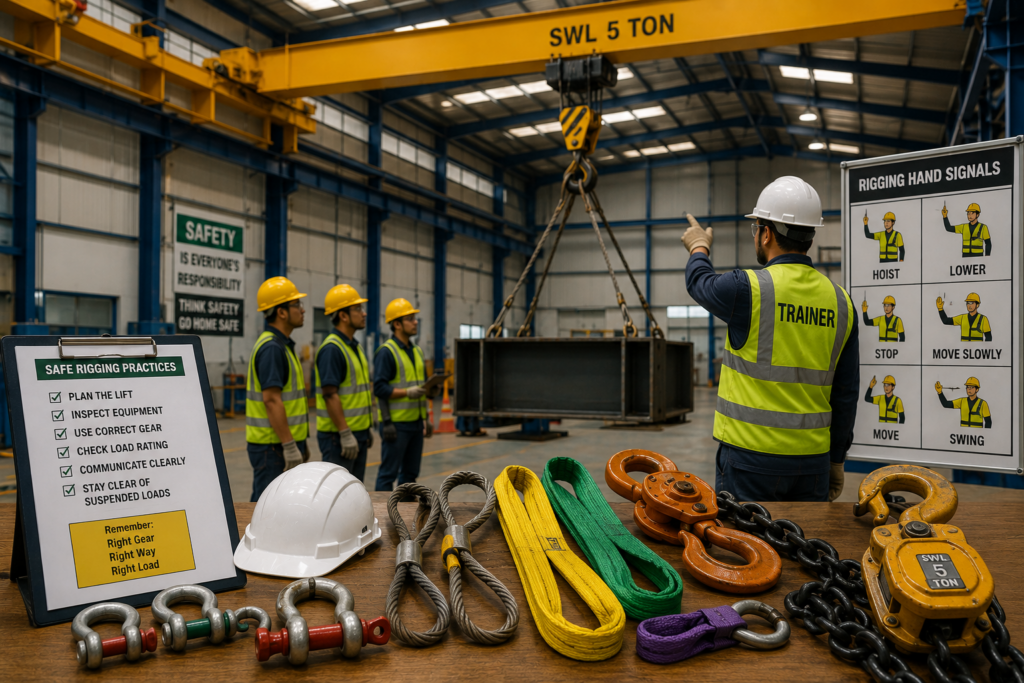
Participants will gain an understanding of crane components, lifting accessories, rigging methods, signalling systems, and the responsibilities of crane operators, riggers, and signallers. Emphasis is placed on accident prevention, proper communication, load stability, and safe work procedures to minimize risks associated with lifting operations.
The course combines classroom theory, case studies, demonstrations, and practical discussions to enhance competency and promote a strong safety culture during lifting and hoisting operations. By the end of the training, participants will be better prepared to perform lifting activities safely, efficiently, and in accordance with industry best practices and legal requirements.
Overhead Crane and Rigging Training is an HRDC Claimable in-house safety programme designed to equip operators, technicians, and lifting personnel with essential knowledge of safe crane operations and rigging practices. Participants will learn lifting safety requirements, rigging techniques, load handling procedures, hazard identification, and best practices to prevent workplace accidents.
Course Objectives
At the end of this training program, participants will be able to:
Understand the basic principles and components of overhead crane systems and rigging equipment.
Identify workplace hazards associated with overhead crane operations and rigging activities.
Explain the roles and responsibilities of crane operators, riggers, and signallers during lifting operations.
Demonstrate proper pre-use inspection procedures for cranes, hooks, slings, shackles, wire ropes, and lifting accessories.
Apply safe lifting and rigging techniques to ensure load stability and control during hoisting operations.
Interpret load charts, safe working loads (SWL), and lifting capacity limitations.
Recognize correct hand signals and communication methods used during crane operations.
Understand safe load handling practices, including load balancing, centre of gravity, and sling angle considerations.
Describe emergency procedures and accident prevention measures related to lifting operations.
Comply with relevant occupational safety and health regulations, standards, and workplace safe work procedures for overhead crane and rigging activities.
Course Content
| Time | Topic | Details |
| 9:00 AM – 10:00 AM | Fundamentals of Overhead Crane Operations | Types of cranes, crane components, terminology, lifting principles |
| Behavior Based Safety | Workplace safety that focusses on human behavior | |
| 10:30 AM – 10:45 AM | Morning Break | |
| 10:45 AM – 12:30 PM | Hazard Identification & Risk Control | Common hazards, unsafe acts, accident case studies, control measures |
| Rigging Equipment & Inspection | Slings, shackles, hooks, wire ropes, inspection procedures | |
| OSHA 1994 & Amendment 2022 | Mandatory Laws, regulations | |
| 12:30 PM – 1:30 PM | Lunch Break | |
| 1:30 PM – 3:30 PM | Safe Rigging & Load Handling Techniques | Sling angles, center of gravity, load balancing, hitch configurations |
| Crane Signals & Communication | Standard hand signals and communication methods | |
| 3:30 PM – 3:45 PM | Afternoon Break | |
| 3:45 PM – 5:00 PM | Safe Operating Procedures | Pre-use inspection, lifting procedures, emergency response |
| Practical Demonstration & Assessment | Rigging demonstrations, crane operation awareness, assessment |
Suggested Training Methodology
Classroom presentation
Practical demonstration
Group discussion
Case study review
Video presentation
Question and answer session
Recommended PPE for Practical Session
Safety helmet
Safety shoes
Hand gloves
Reflective vest