Course Overview
Occupational First Aid & CPR (AED) – 2 Days
Duration: 2 Days
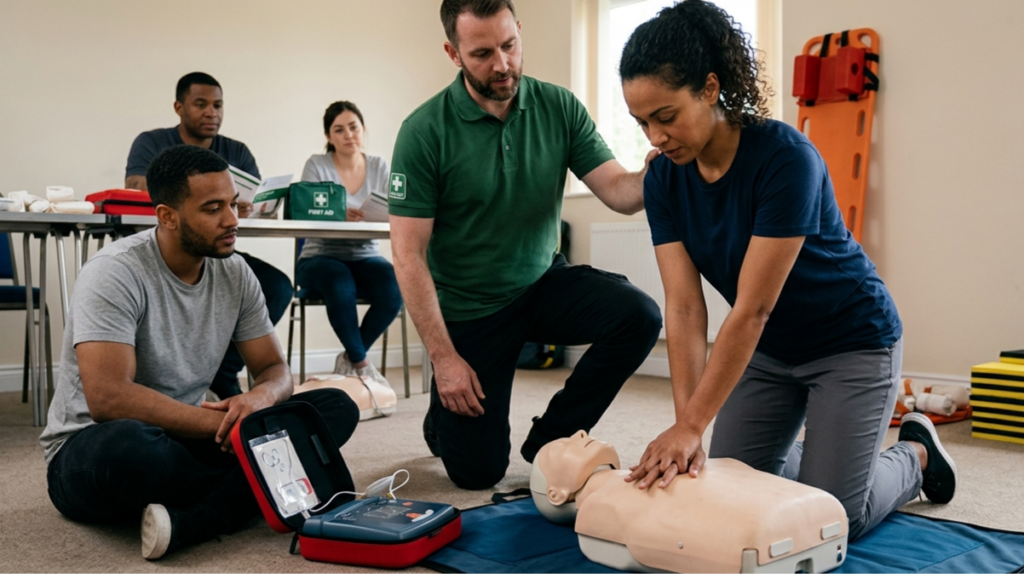
Basic First Aid Training at the Work Place aims to give a more comprehensive coverage on the understanding and practical guidance as well as the theoretical aspects of first aid to the Volunteers and the public based on the concept of prevention. When someone becomes ill or injured, there is usually a short period of time before you can get professional medical assistance. It is that length of time that is most critical to the victim. What you do, or don’t do during that period of time can make the difference between life and death. It has been shown that proper initial handling of the accident victims contributes significantly to the final outcome and often determines if a life could be saved. This program will impart the basic practical knowledge of First Aid.
Course Objectives
The objectives of the Occupational First Aid & CPR (AED) Training are:
- To respond to emergencies safely
- Understand basic first aid principles and its procedures
- To recognize, assess and support the most common emergencies until professional help arrives
- Be aware of the importance of proper safety procedures
- Identify common injuries at the work place and how to deal with them.
Learning Outcomes
Based on the existing Course Objectives, participants will be able to:
- Respond to emergencies safely
- Understand basic first aid principles and its procedures
- Recognize, assess and support the most common emergencies until professional help arrives
- Be aware of the importance of proper safety procedures
- Identify common injuries at the work place and how to deal with them.
Methodology
All the training sessions will be conducted through:
- Lectures
- Hands-on practical sessions
- Power point presentations
- Practical simulation exercise
- Group work
- Case studies
- Activities
- Assessment
Who Should Attend
This Occupational First Aid & CPR (AED) Training is suitable for:
- Safety & Health committee members, ERT / First Aid committee members
- HR Personnel, Supervisors / Site Supervisors, Safety Officers, Electricians/ Charge man
- Contractors, Others who are interested in first aid, Family with children & senior citizen
- Life guard, Chef
Course Content
Scope of 1st Aid
- Objective of 1st Aid
- Primary & secondary survey
- Scene survey & danger assessment
- 1st Aid guideline, act / legal provision
- 1st Aid box
Respiratory System
- Anatomy & function of lungs & how the lungs work
- Mechanism of breathing
- Composition of air and breathing rate
- Respitatory disease and emergency management (etc. asthma)
Circulation System
- Anatomy & function of heart
- Pulse & Blood pressure
- Type of blood vessels and characteristics
- Blood & contents & coronary artery diseases
- Risk factor, sign of heart attack & management
- Stroke & emergency management
Wound / Bleeding & Management
- Types & classification of bleedings
- Cause of nose bleed and management
- Open & closed wound identification & management
- Bandaging techniques for:
- Wounds, head injury & eye injury
- Traumatic amputation & impaled foreign object
Shock, Fainting & Unconscious
- Definition & cause shock
- Sign & symptom & management shock
- Fainting & unconscious management
Burns & Scalds
- Cause, types & degrees of severity
- Management using of 3Cs (cool, cover & carry)
- Emergency management for chemical burns
Foreign Body Airway Obstruction
- Identifying of partial or complete airway obstruction
- Universal sign of airway obstruction (choking)
- Management of choking victim (conscious & unconscious)
- Adult
- Child
- Infant
- Pregnant & obese
Fractures & Splinting Techniques
- Identifying close & open fractures (types of fractures)
- Sign & symptom
- Immobilization & splinting of:
- Upper limbs & collar bone
- Lower limbs
- Management of joints & muscle injuries
Lifting & Transporting
- Application of cervical collars
- Log roll stretcher technique
- All types of carry & lifting technique
- Stretcher carry and loading victim in ambulance
Cardio Pulmonary Resuscitation (CPR)
- What is CPR / why & when to perfume CPR
- Clinical & biological deaths
- Causes of sudden death
- What is cardiac arrest & heart attack
- Chain of survival
- The DRABC & DRCAB principles of CPR
- Hand only CPR
- How to use AED (procedure & precautions)
- How to call for help (ERP, ERT & MERS 999)
- When to stop CPR
Poisoning
- Type of poisoning & management
Injury Stimulation & Mock Drills
- Role play & team work in an Emergency
- Mock stimulation
- Post mortems
- Written test
- Evaluation & Q&A session
Timeline Table
Day 1
| Time | Topic | Method |
|---|---|---|
| 09:00 – 09:15 | Registration, Introduction & Course Objectives | Lecture |
| 09:15 – 10:15 | 1. Scope of First Aid
| Lecture |
| 10:15 – 11:00 | 2. Respiratory System
| Lecture |
| 11:00 – 11:20 | Tea Break | |
| 11:20 – 13:00 | 3. Circulatory System
| Lecture |
| 13:00 – 14:00 | Lunch Break | |
| 14:00 – 15:30 | 4. Wounds, Bleeding & Management
| Lecture & Demonstration |
| 15:30 – 15:50 | Tea Break | |
| 15:50 – 16:45 | Bandaging Practical Session
| Practical |
| 16:45 – 17:30 | 5. Shock, Fainting & Unconscious Casualty
| Lecture & Practical |
Day 2
| Time | Topic | Method |
|---|---|---|
| 09:00 – 09:15 | Recap of Day 1 | Discussion |
| 09:15 – 10:00 | 6. Burns & Scalds
| Lecture |
| 10:00 – 10:45 | 7. Foreign Body Airway Obstruction (Choking)
| Lecture & Demonstration |
| 10:45 – 11:00 | Tea Break | |
| 11:00 – 13:00 | 8. Fractures & Splinting Techniques
| Demonstration & Practical |
| 13:00 – 14:00 | Lunch Break | |
| 14:00 – 14:45 | 9. Lifting & Transporting
| Practical |
| 14:45 – 16:00 | 10. Cardiopulmonary Resuscitation (CPR) & AED
| Practical & Assessment |
| 16:00 – 16:15 | Tea Break | |
| 16:14 – 16:45 | 11. Poisoning Management | Lecture |
| 16:45 – 17:30 | 12. Mock Drill, Written Test, Evaluation & Q&A | Simulation & Assessment |