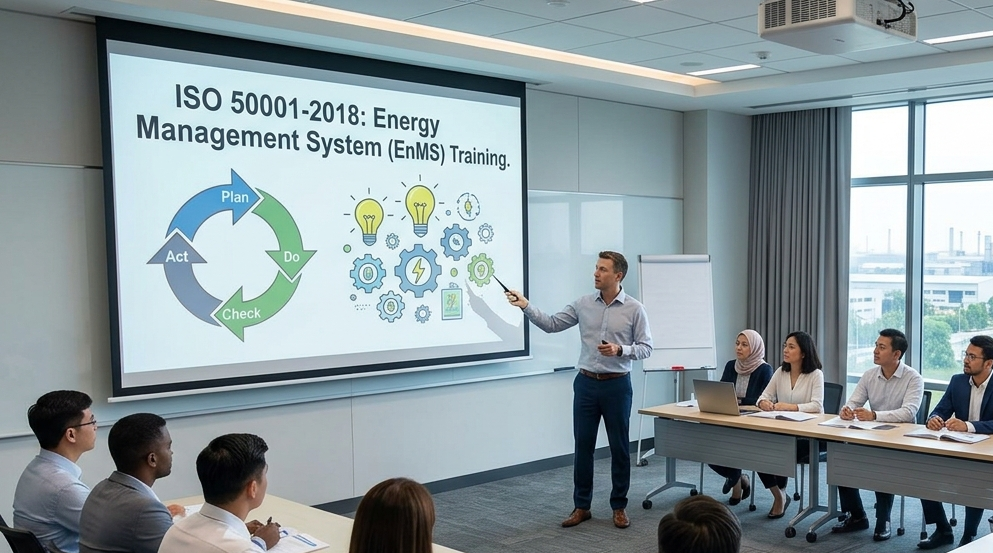
Course Overview
ISO 50001 2018 Energy Management System (EnMS)
Duration: 2 Days
Training Duration: 2 Days (9.00am to 5.00pm)
These 2 days “ISO50001 2018 Energy Management System” training provides any organisation to pursue, following a systematic approach, the continuous improvement of its own energy performance, including:
- More efficient energy use and better use of the organisation’s energy consuming assets
- Energy efficiency
- Reduction of energy costs
The ISO 50001 is a specifically designed tool for EnMS and it provides stake holders with clear guidance for effective operations on a day-to-day basis which leads to energy and cost savings.
Course Objectives
At the end of the ISO 50001 2018 Energy Management System programme, participants will be able to:
- Understanding the background to ISO 50001-Rev2018 and 2025 new inclusions
- Know and apply the guidance and application for energy management systems provided by ISO 50001
- Able to use the necessary tools and knowledge to establish, implement and monitor an EnMS
- Know why an effective Energy Management System is important to an organization
- Know the thorough examination of the requirements of ISO50001
- Explore and know how to implement an EnMS to meet the requirements of ISO 50001.
- Understand the purpose of ISO 50001 and the benefits
- Able to outline the key concepts and approaches to an energy management system
- Know how to apply Plan-Do-Check-Act (PDCA) cycle, the support scope and purpose of ISO 50001
- Understand key ISO 50001 definitions, terminology, and key requirements
- Able to apply relevant energy management system legislation to comply to ISO50001
Who Should Attend
This ISO 50001 2018 Energy Management System programme is suitable for:
- Managers
- Supervisors
- Engineers
- Technicians
- IQA Audit Team
- Facility Department
- EHS Officer
- QMR
Methodology
Participants will be involved in:
- 70% virtual lectures through face to face or webinar
- 20% breakout room group discussions, exercises and work assignments
- 10% selected video presentations sharing
Pre test and Post test together with ISO 50001 2018 Energy Management System Training evaluation establish the reaction feedback and measurable for the initial learning.
Course Content
Day 1 – ISO 50001:2018 Energy Management System Fundamentals And Planning
Module 1: Introduction To ISO 50001:2018 Energy Management System (EnMS) Overview
- Pre Test – Current knowledge assessment on subject
- Energy Policy approval
- Energy data collection
- Manual and/or Procedures drafting
- Energy Review
- Internal Audit preparation and execution
- Management Review
Module 2: The Hierarchical Structure Of ISO 50001
Context
- ISO50001 – Standards – Management systems
- Context
- Needs of Stakeholders
- Scope of EnMS
- EnMS Processes
Leadership
- Leadership and Commitment
- Energy Policy
- Organizational Approach
Planning
- Hazards
- Risks and Opportunities
- Energy – Objectives, Target and Planning
- Energy Review
- Energy Performance Indicators
- Energy Baseline
- Planning – Collect data on Energy
Support
- Resources – Human, Material, Budget, Machineries, Tools
- Competency
- Awareness
- Communication
- Documented Information
Operation
- Operational Planning and Control
- Design
- Procurement
Evaluation
- EnMS
- Internal Audit
- Management Review
Improvement
- Non Conformity and Corrective Actions
- Continuous Improvement
- Sustainability Success
Module 3: ISO 50001 – Aims And Benefits
Aims
- Assist organisations in making better use of their existing energyconsuming assets
- Create transparency and facilitate communication on the management of energy resources
- Promote energy management best practices and reinforce good energy management behaviours
- Assist facilities in evaluating and prioritising the implementations of new energy-efficient technologies.
- Provide a framework for promoting energy efficient throughout the supply chain
- Facilitate energy management improvements for GHG emission reduction projects
- Allow integration with other management systems
Benefits
- Save money
- Avoid waste
- Increase efficiency
- Improve behaviours concerning energy
- Increase resilience to change
- Energy costs
- Fuels
Module 4: Basis – PDCA (Dr Edward Deming’s Quality Tool)
- Plan
- Do
- Check
- Act
- The Flow
- Energy Policy
- Energy Planning
- Implementation and Operation
Checking
- Monitoring Measurement
- Internal Audit
- Management Review
Energy
- Electricity
- Fuel
- Steam
- Heat
- Compressed air and other like media
Note: Energy refers to the various forms of energy, including renewable, which can be purchased, stored, treated, used in equipment or in a process or recovered.
Module 5: 4.1 General Requirements
- Maintain an Energy Management System (EnMS) to ISO 50001
- Define and document the system’s scope and boundaries
- Define how ISO 50001 will be met and how it will achieve continual improvement
- Energy Performance
- Energy Intensity
- Energy Use
- Energy Consumption
- Energy Efficiency
Module 6: 4.2 Management Responsibility
4.2.1 Top Management
- Define, establish and implement Energy Policy
- Appoint a Management Representative
- Approve the formation of Energy Management Team
- Provide resources
- HR, Skills, technology and finance
- Identify scope and boundaries
- Communicate importance of EnM
- Ensure objectives and targets set
- Ensure EnPIs appropriate
- Consider En performance in long term planning
- Ensure results measured and reported at determined intervals
- Conduct Management Reviews
4.2.2 Management Representative
- Appointed by Top Management
- Ensuring the EnMS is established, implemented, maintained and improved
- Identify support members of EnM team
- Reporting on the performance of the EnMS
- Ensure planning supports EnM policy
- Define and communicate responsibilities and Authorities
- Define criteria for an effective EnMS
- Promote awareness of EnMS
Module 7: 4.3 Energy Policy
Who
- Top Management
What
- A commitment to improve energy performance
Where – Boundaries And Scope
- Appropriate to nature and scale
Commitment To
- Continual improvement
- Availability of information and resources to achieve objectives and targets
- Compliance with legislation and other requirements
- Provides a framework for setting and reviewing objectives and targets
- Supports purchase of Energy efficient products/services
- Supports design for Energy performance improvement
- Documented and communicated
- Regularly reviewed
- Updated as necessary
Module 8: 4.4 Energy Planning
4.4.1 General
- Conduct energy planning process
- Consistent with Energy Policy and lead to improved performance
- Involve a review of organisation’s activities that can affect Energy performance
4.4.2 Legal And Other Requirements
- Identify and have access to legal and other requirements
- Determine how these requirements apply to energy use, consumption and efficiency
- Ensure consideration in establishing, implementing and maintaining EnMS
4.4.2 Legal Requirements?
- National and International Legislation
- State/provincial/department laws
- Local government requirements
Energy Planning Process
Planning Inputs
- Past and Present Energy uses
- Relevant variables and Performances
Energy Review
- Analyse consumption
- Identify significant use
- Identify improvement opportunities
Planning Outputs
- Baseline
- EnPIs
- Objectives
- Targets
- Action plans
4.4.3 Energy Review
- Analyse energy use based on data
- Identify current sources
- Evaluate past and present energy use
- Based on analysis
- Identify significant energy uses.
- Identify facilities, equipment, systems, processes and personnel that significantly affect energy use.
- Identify other relevant variables
- Determine current energy performance of facilities, equipment, systems and processes
- Estimate future energy use
- Identify and prioritise opportunities for improvement
- Reviews to be recorded
- Methodology shall be documented
- Reviews shall be at defined intervals
- Reviews shall also be triggered by major changes of:
- Equipment
- Systems
- Processes
4.4.4 Energy Baseline
- Energy baseline shall be established
- Using information from initial Energy review
- Data periods suitable to use patterns
- Changes shall be measured against baseline
Adjustments To Baseline When:
- EnPIs no longer reflect En use
- There have been major changes
- According to a predetermined method
- Baseline data to be recorded
4.4.5 Energy Performance Indicators (EnPI)
- EnPIs shall be identified
- Appropriate for monitoring performance
- Methodology for determining and updating EnPIs shall be:
- Recorded
- Regularly reviewed
- EnPIs shall be reviewed and compared to the EN Baseline
4.4.6 Energy Objectives, Targets And Action Plans(s)
- Establish, implement and maintain documented energy objectives and targets at relevant levels / functions
- Objectives – Consistent with policy
- Targets – Consistent with objectives
- O&T shall be “framed” / SMART
Objectives And Targets Shall Take Into Account
- Significant energy uses
- Technological options
- Financial, operational and business conditions
- Legal requirements
- Views of interested parties
Action Plans Shall Include
- Designation of responsibilities
- Means and timeframe for targets
- Method for verifying success
- Verification results
- Action plans shall be documented
- Update action plans shall at defined intervals
Day 2 – ISO 50001:2018 Implementation, Checking, Review And Energy Efficiency
Module 9: 4.5 Implementation And Operation
General
- Action plans and other outputs from the planning process shall be used for implementation and operation
4.5.2 Competence Training And Awareness
- Personnel working for or on its behalf related to significant energy uses shall be competent on the basis of education, training, skills or experience.
- Training needs shall be identified
- Based on operation of EnMS
- Based in control of its significant energy uses
- Provide training or take other actions to meet training needs
- Maintain appropriate records
Persons Working For Or On Its Behalf Shall Be Made Aware Of:
- Importance of conformity with EnMS
- Their roles, responsibilities and authorities
- Benefits of improved energy performance
- The impact of their actions and behaviours (actual and potential / positive and negative) on energy use and the achievement of objectives and targets
4.5.3 Communication
- Communicate internally on energy performance and the EnMS
- Appropriate to organisation’s size
- Implement a process by which all persons can make comments or suggest improvements
- Decide whether to communicate externally about its energy policy, EnMS and energy performance.
- Document its decision
4.5.4 Documentation
4.5.4.1 Documentation Requirements
- Core elements and interactions shall be documented
- Scope and boundaries
- Energy policy
- Objectives, targets and action plans
- Documents/records required by ISO 50001
Degree Of Documentation Depends On:
- Scale of organisation
- Type of activities
- Complexity of processes and their interactions
- Competence of personnel
4.5.4.2 Control Of Documents
- Records and documents required by EnMS shall be controlled
- Approved before use
- Reviewed periodically
- Changes and revision status identified
- Available where needed
- Legible and identifiable
- Control over external documents
- Obsolete documents identified
4.5.5 Operational Control
- Operations associated with significant energy aspects shall be identified and planned
- Ensure consistency with energy policy, objectives, targets and action plans
- Ensure operations are carried out under specified conditions
Specific Actions
- Setting criteria for operation and maintenance
- Operating to set criteria
- Appropriate communication of operational controls
4.5.5 Note – Emergency / Contingency Planning
An organisation may choose to include energy performance in determining how it will react to these situations.
4.5.6 Design
- Consider energy performance in design of new, modified and renovated facilities, equipment
- Input: Energy performance evaluation results
- Output: records
4.5.7 Procurement
- Services, products, equipment and energy
- Partly evaluated on energy performance
- Establish criteria for evaluation based on:
- Consumption
- Efficiency
- Lifetime energy costs
- Document energy purchasing specifications
Module 10: 4.6 Checking
4.6.1 Monitoring And Measurement
- Key characteristics that determine energy performance
- Monitored
- Measured
- Analysed
Key Characteristics Shall Include:
- Significant energy uses
- Output of energy review
- Relevant variables
- EnPIs
- Effectiveness of action plans
- Actual v. Expected
- An energy management plan, shall be defined and implemented
- Appropriate to size and complexity.
- Measurement equipment shall be accurate and reliable
- Records of calibration to be maintained
- Or other means of establishing accuracy and repeatability.
- Investigate and respond to significant deviations in energy performance
- Maintain results of these activities
4.6.2 Evaluation Of Compliance With Legal And Other Requirements
- Evaluate compliance at planned intervals
- Records to be maintained of compliance evaluations
4.6.5 Control Of Records
- Establish and keep records necessary to demonstrate conformity
- EnMS compliance and performance and ISO 50001 (EnMS)
- Record controls shall be defined and implemented
- Identification, retrieval and retention
- Legibility, identification, traceability, media etc
Module 11: 4.7 Management Review
4.7.1 General
- Review the EnMS
- Planned intervals
- Ensure continuing suitability, adequacy and effectiveness
- Records to be maintained
4.7.2 Inputs To Management Review
- Follow up from previous reviews
- Review policy
- Review energy performance and related EnPIs
- Evaluation of legal and other requirements
- Extent to which objectives and targets met
- Results of EnMS audits
- Status of corrective/preventive actions
- Projected energy performance
- Recommendations for improvement
4.7.3 Outputs From Review
- Changes in energy performance
- Changes in energy policy
- Changes to EnPIs
- Changes in objectives, targets and other elements
- Consistent with improvement
- Changes to allocation of resources
Frequently Asked Questions
What Is Significant?
Consider the following:
- Major energy uses
- Major energy costs
- Views of stakeholders
- Involving your employees
- Availability of expertise
- Sustainability
- Policy, Objective, Target
- Improve energy efficiency
Module 12: Forms Of Energy
- Thermal (Heat / cooling)
- Noise / Vibration
- Electromagnetic / Light / Radiation
- Kinetic / Movement
- Magnetic / Electricity
- Electrochemical
- Chemical
- Potential / Hydroelectric / Wind / Elastic / Pressure
- Nuclear
Techniques Used In Energy Efficiency
- The ”Onion” Diagram – Energy Demand
- Good Housekeeping
- Operation & Maintenance
- Control
- Plant
- Process
- Energy Service
Module 13: Review Of Systems
Collect Data On The Current Operation
- Review operation parameters
- Cycle times
- Operating hours
- Temperatures / Make-up air etc.
- Flow rates / speeds
Key: Understanding of safety / product quality / required environment
Review Of Equipment
- Run / standby
- Maintenance routines
- Leakage
- Condensation / insulation
- Controls
Module 14: 7 Deadly Wastes
- Over processing (intensity)
- Inventory / Work-In-Progress
- Defects / Rework / Waste
- Waiting
- Excessive motion / work steps
- Transport / unnecessary movement
- Over Production (quantity)
- Failure to use human potential
Module 15: Potential Savings – Common Areas Of Energy Use Improvement
Combustion
- Off gas / NOx
- Unburnt fuel
- Conduction / radiation
- Unburnt residues
- Flue gas temperature
- Increase heat transfer
- Correct sizing
- Preheater
- Maintenance
- Burner control
- Fuel choice
- Reduce furnace openings
Electricity
- Transformers
- Motor Sizing
- 68% of energy in industry
- Frequency converters, variable speed drives (VSD), Adjustable frequency drives (AFD), inverters etc.
- Energy Efficient Motors (EEM)
- Motor Repairs
- Rewinding
Compressors
- ISO 11011 – Compressed air systems – energy assessments
- High Efficiency Motors
- Control systems
- Heat Recover
- Leak reduction
- Filter maintenance
- Cooling system: Air or Oil
- Optimising pressure
- Adjust mechanical pressure sensors
- Optimise compressor sizes
- Optimised intelligent control
Pumps
- Inventory and Assessment
- Pump selection
- Pipework systems
- Maintenance
- Motor selection
- Shut down when not needed
- Multiple pumps
Heating
- Typical HVAC system used
- Ventilation
- Design optimisation
- Rebalancing
- Free cooling
- Building Energy Management System (BEMS)
Lighting
- Lighting levels
- Equipment selection: LED, CFL etcs
- Maintenance
- PIR controls
Module 16: Conclusion
- Training summary
- Post Test – Assessment
- Pre and Post Test – Questionnaires review
- Training evaluation