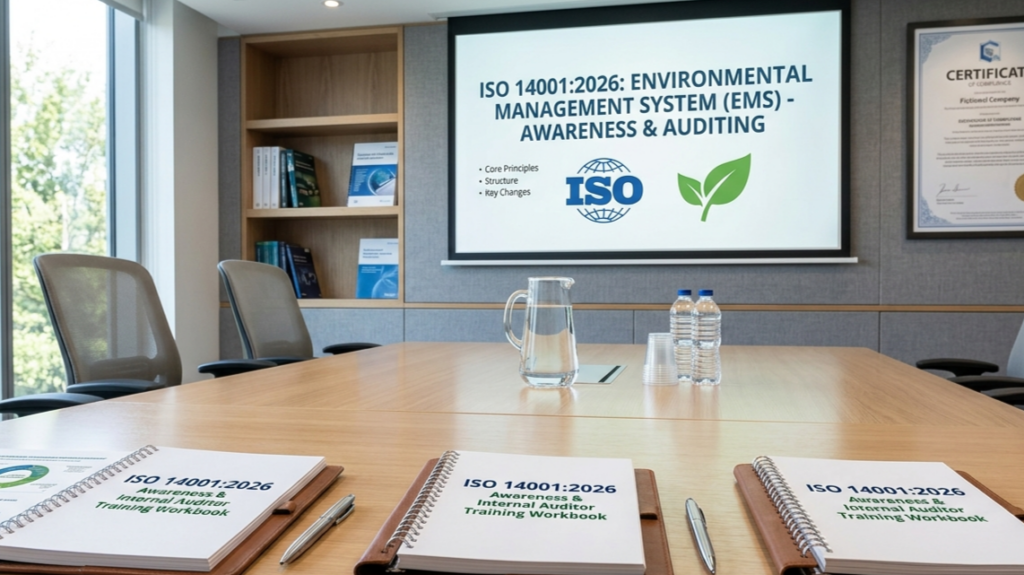
Course Overview
ISO 14001:2026 Awareness Training & Internal Auditing Training : ISO 14001 aims to provide an understanding of the environmental responsibilities of organizations, groups, and individuals. The Environmental Management System (EMS) is the key management practice in ISO 14001.
IA, an efficient internal audit procedure is crucial to a good Environmental Audit. It helps to locate system faults or oversees and allows corrective action to be taken.
In today’s global business environment, environmental sustainability has become a key priority for organizations across all industries. Compliance with environmental regulations and international standards such as ISO 14001 is no longer optional but a strategic requirement. This training course is designed to provide participants with a comprehensive understanding of Environmental Management Systems (EMS) and how they can be effectively implemented, maintained, and improved within an organization.
Participants will also be exposed to the importance of internal auditing as a critical tool in ensuring compliance, identifying gaps, and driving continual improvement. A well-structured internal audit process not only ensures adherence to ISO requirements but also strengthens organizational performance by identifying risks, inefficiencies, and opportunities for improvement.
Course Objectives
- To understand the key changes and new requirements introduced in the 2026 version.
- To assess the impact of changes on policies, procedures, and controls.
- To prepare the organization for a smooth certification transition within the required timeframe.
- Prepare, conduct and follow up on ISO 14001 audit activities.
- Gain the skills to assess an organization’s capability to manage its Environmental Management System.
- Write factual audit reports.
- Improving audit effectiveness in your company.
In addition to the above objectives, participants will also develop a deeper understanding of environmental compliance obligations and how ISO 14001 supports sustainable business practices. The course will equip participants with practical auditing techniques that can be applied in real workplace situations, ensuring that audits are not only compliant but also value-driven.
Who Should Attend
Environmental Management Representatives, Internal Auditors, Top Management, Key Personnel involved in implementing and managing EMS.
This course is also highly suitable for compliance officers, safety and health personnel, quality managers, and sustainability coordinators who are responsible for ensuring environmental performance and regulatory compliance within their organizations. It is particularly beneficial for individuals who are directly involved in audit planning, execution, and reporting activities.
Course Content
SECTION 1: INTRODUCTION TO ENVIRONMENTAL AWARENESS
- Definition of environmental awareness
- Environmental impacts of daily activities
- The business case for environmental responsibility
SECTION 2: TRANSITION RULES AND TIMELINES
- Preparation for it.
- Timeline
SECTION 3: KEY CHANGES ISO14001:2026
- Why is ISO 14001 being updated?
- Overview of the 2026 revision
- Clause update
- General changes
SECTION 4: INTERPRETATION OF ISO 14001:2026 REQUIREMENTS AND CHANGES
- Documented Procedures
- ISO 14001:2026 Environmental Management Systems Requirements
- Clause 4: Context of the organization
- Clause 5: Leadership
- Clause 6: Planning
- Clause 7: Support
- Clause 8: Operation
- Clause 9: Performance Evaluation
- Clause 10: Improvement
SECTION 5: INTRODUCTION TO INTERNAL AUDIT
- Reasons to Audit
- Requirements of Auditing Standards
- Audit Process
- Principles of Audit
- Attribute of Auditor
- Terms & Definitions (ISO 19011:2018)
- Knowledge & Skills of Auditor
- Generic Knowledge & Skills of Audit Team Leaders
- Communication Skills
SECTION 6: AUDIT PLANNING
- Extent of an Audit Programme
- Audits Preparation
- Audits Notification
- Audit Plan/ Schedule
SECTION 7: AUDIT PROCESS
- Audit Preparation
- Opening Audit Meeting
- The Audit Triangle Cycle
- Observation
- Style of Questioning
- Special Technique To Check / Audit
- Documenting Audit Results / Findings
Closing Audit Meeting