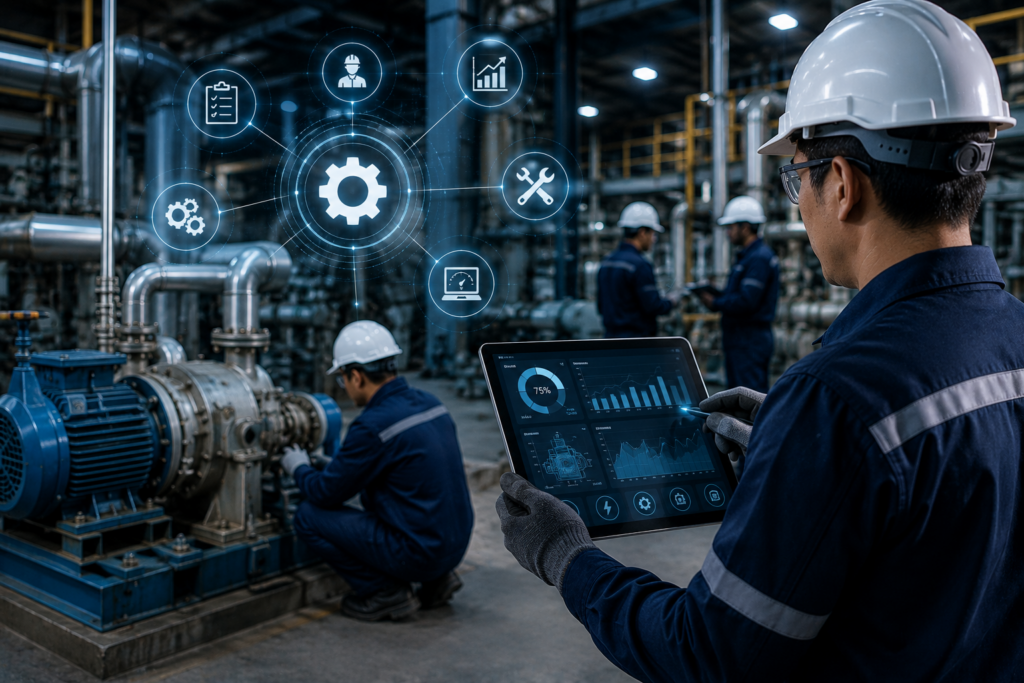
Integrated Maintenance Management Program (IMMP)
Integrating Total Productive Maintenance (TPM), Preventive Maintenance (PM), Predictive Maintenance (PdM) and Reliability Maintenance
In today’s highly competitive industrial environment, organizations are under constant pressure to improve productivity, reduce operating costs, enhance equipment reliability, and ensure safe operations. Equipment and physical assets represent significant investments, and their performance directly affects production output, product quality, operational efficiency, and profitability.
Traditionally, many organizations relied heavily on reactive maintenance practices, where maintenance activities were performed only after equipment failures occurred. While this approach may appear cost-effective in the short term, it often results in unplanned downtime, increased repair costs, reduced asset life, production losses, safety incidents, and customer dissatisfaction.
As industries continue to embrace automation, digitalization, and operational excellence initiatives, maintenance has evolved from a support function into a strategic business process. Modern organizations now recognize that effective maintenance management is critical to achieving sustainable business performance and maximizing return on asset investments.
The Need for Integrated Maintenance
No single maintenance strategy can effectively address all equipment reliability challenges. Organizations that rely solely on preventive maintenance may experience unnecessary maintenance interventions, while those focusing only on predictive maintenance may overlook fundamental maintenance discipline and operator involvement. Similarly, reliability improvement initiatives often fail when maintenance execution and workforce engagement are weak.
To overcome these challenges, leading organizations are adopting an Integrated Maintenance Management Program (IMMP) that combines the strengths of multiple maintenance methodologies into a unified asset management framework.
This integrated approach combines:
Total Productive Maintenance (TPM)
- Promotes operator ownership and accountability.
- Encourages proactive equipment care.
- Drives continuous improvement and operational excellence.
- Focuses on maximizing Overall Equipment Effectiveness (OEE).
Preventive Maintenance (PM)
- Establishes planned maintenance activities.
- Reduces equipment deterioration.
- Improves equipment availability and compliance.
Predictive Maintenance (PdM)
- Utilizes condition monitoring technologies.
- Detects potential failures before breakdowns occur.
- Enables data-driven maintenance decisions.
- Optimizes maintenance intervals and resource utilization.
Reliability Maintenance
- Focuses on eliminating recurring failures.
- Applies engineering tools such as Root Cause Failure Analysis (RCFA), Failure Mode and Effects Analysis (FMEA), and Reliability-Centered Maintenance (RCM).
- Improves long-term asset reliability and lifecycle performance.
Integrated Maintenance Philosophy
The Integrated Maintenance Management Program recognizes that equipment reliability is not solely the responsibility of the maintenance department. Rather, reliability is achieved through collaboration among operations personnel, maintenance teams, engineering staff, management, and support functions.
Under this philosophy:
- Operators maintain basic equipment conditions through Autonomous Maintenance.
- Maintenance personnel execute planned maintenance activities.
- Reliability engineers analyze failure patterns and optimize maintenance strategies.
- Management provides leadership, resources, and performance monitoring.
- Cross-functional teams drive continuous improvement initiatives.
The result is a comprehensive maintenance system that balances equipment reliability, operational efficiency, safety, environmental compliance, and cost optimization.
Key Benefits of Integrated Maintenance
Organizations implementing an Integrated Maintenance Management Program can expect:
- Improved equipment reliability and availability.
- Reduction in unplanned downtime.
- Increased Overall Equipment Effectiveness (OEE).
- Lower maintenance and lifecycle costs.
- Enhanced workplace safety.
- Extended asset life.
- Improved maintenance planning and scheduling.
- Better utilization of maintenance resources.
- Increased employee engagement and ownership.
- Improved operational performance and profitability.
Course Objectives
Upon completion of this program, participants will be able to:
- Explain the principles and interrelationship of Total Productive Maintenance (TPM), Preventive Maintenance (PM), Predictive Maintenance (PdM), and Reliability Maintenance in achieving sustainable asset performance.
- Develop and implement an Integrated Maintenance Management Program (IMMP) that aligns maintenance activities with organizational goals, operational requirements, and asset reliability objectives.
- Apply maintenance planning, scheduling, and preventive maintenance techniques to improve equipment availability, reduce downtime, and optimize maintenance resources.
- Utilize predictive maintenance and condition-monitoring technologies to identify potential equipment failures and support data-driven maintenance decisions.
- Apply reliability engineering tools and methodologies, including Root Cause Failure Analysis (RCFA), Failure Mode and Effects Analysis (FMEA), and Reliability-Centered Maintenance (RCM), to eliminate recurring failures and improve asset reliability.
- Measure and improve maintenance performance using key performance indicators (KPIs) such as Overall Equipment Effectiveness (OEE), Mean Time Between Failures (MTBF), Mean Time to Repair (MTTR), and asset availability to support continuous improvement initiatives.
Learning Objectives
By the end of this program, participants will be able to:
- Describe the concepts, principles, and benefits of Total Productive Maintenance (TPM), Preventive Maintenance (PM), Predictive Maintenance (PdM), and Reliability Maintenance.
- Identify critical equipment failure modes, maintenance requirements, and reliability risks that impact asset performance and operational efficiency.
- Develop effective preventive and predictive maintenance strategies to minimize equipment downtime and extend asset life.
- Apply reliability improvement tools such as Root Cause Failure Analysis (RCFA), Failure Mode and Effects Analysis (FMEA), and Reliability-Centered Maintenance (RCM) to address recurring equipment failures.
- Evaluate maintenance performance using key indicators such as Overall Equipment Effectiveness (OEE), Mean Time Between Failures (MTBF), Mean Time to Repair (MTTR), and equipment availability.
- Design an integrated maintenance improvement plan that combines TPM, PM, PdM, and Reliability Maintenance principles to enhance equipment reliability, productivity, safety, and cost effectiveness.
Learning Methodology
This program adopts a highly interactive and workshop-based learning approach designed to maximize participant engagement, knowledge retention, and practical application. The training combines theoretical concepts with real-world maintenance scenarios, enabling participants to immediately apply the knowledge and tools learned within their respective organizations.
The learning methodology includes:
- Interactive Facilitated Discussions
Participants will engage in guided discussions to share experiences, discuss maintenance challenges, and explore industry best practices related to TPM, Preventive Maintenance, Predictive Maintenance, and Reliability Maintenance.
- Practical Workshops and Group Exercises
Participants will work individually and in teams to complete structured exercises involving maintenance planning, asset criticality assessment, reliability improvement strategies, maintenance KPI analysis, and integrated maintenance framework development.
- Case Studies and Problem-Solving Sessions
Real-life maintenance and reliability case studies will be analyzed to identify root causes of equipment failures, evaluate maintenance effectiveness, and develop practical improvement solutions.
- Maintenance Assessment and Diagnostic Activities
Participants will assess existing maintenance practices, identify performance gaps, and evaluate opportunities for implementing integrated maintenance strategies within their organizations.
- Reliability and Maintenance Tools Application
Hands-on exercises will be conducted using industry-standard tools and techniques such as:
- Overall Equipment Effectiveness (OEE)
- Root Cause Failure Analysis (RCFA)
- Failure Mode and Effects Analysis (FMEA)
- Reliability-Centered Maintenance (RCM)
- Asset Criticality Assessment
- Maintenance KPI Monitoring
- Group Presentations and Knowledge Sharing
Participants will present workshop findings, discuss improvement recommendations, and exchange best practices to reinforce learning and encourage cross-functional collaboration.
- Action Planning Workshop
At the end of the program, participants will develop a practical maintenance improvement action plan that can be implemented within their respective departments or facilities to improve asset reliability, maintenance effectiveness, and operational performance.
“Learn – Discuss – Apply – Improve”
The program emphasizes experiential learning, collaborative problem-solving, and practical application to ensure participants gain actionable skills and tools that can be immediately implemented in the workplace.
Course Outline
DAY 1
Building the Foundation of Integrated Maintenance
Session 1: Introduction to Modern Maintenance Management
- Understand the evolution of maintenance strategies
- Recognize the limitations of reactive maintenance
- Appreciate the business value of integrated maintenance
- Evolution of maintenance:
- Reactive Maintenance
- Preventive Maintenance
- Predictive Maintenance
- Reliability Maintenance
- TPM
- Cost of equipment failures
- Maintenance as a strategic business function
- Characteristics of world-class maintenance organizations
- Maintenance maturity self-assessment
Session 2: Integrated Maintenance Management Framework (IMMP)
- Understand how TPM, PM, PdM, and Reliability Maintenance work together
- Develop a holistic maintenance strategy
- Integrated Maintenance Model
- Maintenance hierarchy and governance
- Roles and responsibilities
- Maintenance workflow integration
- Asset lifecycle approach
- Mapping current maintenance practices to the IMMP framework
Session 3: Total Productive Maintenance (TPM)
- Understand TPM philosophy and implementation
- Develop operator ownership and engagement
- History and principles of TPM
- Eight TPM pillars
- Autonomous Maintenance (AM)
- Planned Maintenance
- Focused Improvement (Kaizen)
- Equipment ownership culture
- OEE fundamentals
- Identifying the Six Big Losses
- Calculating OEE
- TPM implementation in manufacturing operations
Session 4: Preventive Maintenance (PM)
- Develop effective PM programs
- Optimize maintenance schedules
- PM philosophy and objectives
- Time-based vs usage-based maintenance
- Maintenance planning and scheduling
- PM task development
- Critical asset identification
- Maintenance standards and procedures
- PM compliance measurement
- Developing a PM checklist
- Creating annual maintenance plans
Session 5: Maintenance Planning and Scheduling
- Improve maintenance efficiency
- Reduce maintenance backlog
- Work order management
- Job planning techniques
- Resource allocation
- Shutdown and turnaround planning
- Spare parts coordination
- Maintenance backlog management
- Planning a major maintenance shutdown
DAY 2
Advanced Reliability & Predictive Maintenance
Session 6: Predictive Maintenance (PdM)
- Understand condition-based maintenance concepts
- Identify suitable predictive technologies
- Predictive maintenance principles
- Condition monitoring strategies
- Failure development curve (P-F Curve)
- Selecting PdM technologies
- Selecting PdM techniques for critical assets
Session 7: Reliability Maintenance Fundamentals
- Improve asset reliability
- Reduce recurring failures
- Reliability concepts
- Failure patterns
- Reliability engineering fundamentals
- Asset criticality analysis
- Failure reporting systems
- Reliability improvement strategies
Reliability Metrics
- MTBF
- MTTR
- Availability
- Reliability Index
- Calculating reliability performance indicators
Session 8: Root Cause Failure Analysis (RCFA) & FMEA
- Identify root causes of equipment failures
- Prevent recurrence of failures
- RCFA methodology
- 5 Why Analysis
- Fishbone Diagram
- Failure Mode and Effects Analysis (FMEA)
- Corrective Action Management
- Conducting RCFA on a recurring equipment failure
- Developing an FMEA worksheet
Session 9: Reliability-Centered Maintenance (RCM)
- Optimize maintenance strategies based on risk
- Improve asset performance
- RCM principles
- Functional failure analysis
- Failure consequences
- Maintenance task selection
- Risk-based maintenance planning
- Applying RCM to a critical production asset
Session 10: Developing an Integrated Maintenance Strategy
- Build a site-specific maintenance roadmap
- Align maintenance with business objectives
- Integrating TPM, PM, PdM, and Reliability Maintenance
- Maintenance governance structure
- KPI dashboard design
- Maintenance digitalization
- CMMS/EAM integration
- Continuous improvement framework
- Developing a maintenance improvement roadmap
Session 11: Action Plan, Assessment & Course Closing
- Group presentation
- Maintenance improvement action plan
- Knowledge assessment
- Feedback session