Course Overview
Ergonomics And Manual Handling Awareness Training
Ergonomics Training focuses on ergonomics and manual handling practices that play an important role in maintaining a safe, healthy, and productive workplace. Ergonomics and manual handling play an important role in maintaining a safe, healthy, and productive workplace. Employees involved in lifting, carrying, pushing, pulling, repetitive movements, or prolonged working postures are exposed to various ergonomic hazards that may lead to Musculoskeletal Disorders (MSDs), fatigue, reduced efficiency, and workplace injuries. Poor ergonomic practices can affect not only employee health but also productivity, quality of work, and overall operational performance.
This 1-day Ergonomics Training program is designed to provide participants with practical knowledge and understanding of ergonomic principles and safe manual handling techniques. The program emphasizes hazard recognition, risk reduction, correct body mechanics, and workplace improvements that can help minimize injuries and improve employee well-being. Participants will also learn practical approaches that can be applied immediately in their daily work activities.
Course Objectives
At the end of this program, participants will be able to:
Understand the principles of ergonomics and manual handling in the workplace
Identify ergonomic hazards and risk factors that contribute to workplace injuries
Recognize signs and symptoms of Musculoskeletal Disorders (MSDs)
Apply proper manual handling techniques for lifting, pushing, pulling, and carrying tasks
Improve workplace safety practices through ergonomic awareness and preventive measures
Who Should Attend
Production and manufacturing operators
Warehouse and logistics personnel
Maintenance and technical staff
Supervisors and team leaders
Office employees exposed to ergonomic risks
General workers involved in manual handling activities
Course Methodology
Interactive lecture and presentation
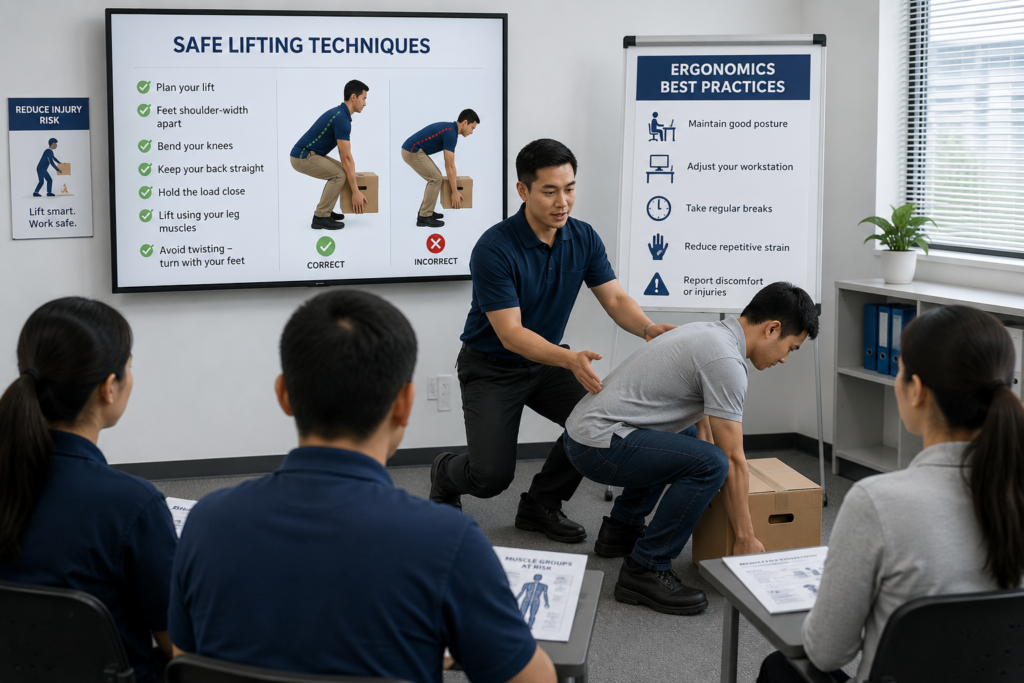
Practical demonstration of manual handling techniques
Group discussion and workplace case studies
Q&A session and experience sharing
Course Content
Module 1: Introduction to Ergonomics & Manual Handling
Understanding Ergonomics
Importance of Manual Handling Safety
Ergonomics in Daily Work Activities
Module 2: Ergonomic Risk Factors
Awkward Postures
Repetitive Movements & Static Work
Forceful Exertion & Workload
Module 3: Musculoskeletal Disorders (MSDs)
Understanding MSDs
Signs & Symptoms of MSDs
Impact of MSDs in the Workplace
Module 4: Safe Manual Handling Techniques
Correct Lifting Techniques
Safe Carrying, Pushing & Pulling
Manual Handling Best Practices
Module 5: Workplace Ergonomic Improvements
Improving Workstation Ergonomics
Stretching & Fatigue Management
Building Ergonomic Awareness Culture
Module 6: Practical Session & Case Study
Practical Demonstration
Workplace Scenario Discussion
Review & Knowledge Sharing
Tentative Program
| Time | Activity |
| 9:00 am – 9:15 am | Registration & Introduction |
| 9:15 am – 10:30 am | Module 1: Introduction to Ergonomics & Manual Handling |
| 10:30 am – 10:45 am | Morning Break |
| 10:45 am – 12:00 pm | Module 2: Ergonomic Risk Factors |
| 12:00 pm – 1:00 pm | Module 3: Musculoskeletal Disorders (MSDs) |
| 1:00 pm – 2:00 pm | Lunch Break |
| 2:00 pm – 3:30 pm | Module 4: Safe Manual Handling Techniques |
| 3:30 pm – 3:45 pm | Afternoon Break |
| 3:45 pm – 4:30 pm | Module 5: Workplace Ergonomic Improvements |
| 4:30 pm – 5:00 pm | Module 6: Practical Session, Discussion & Closing |