Course Overview
Electrical Safety in Work Place
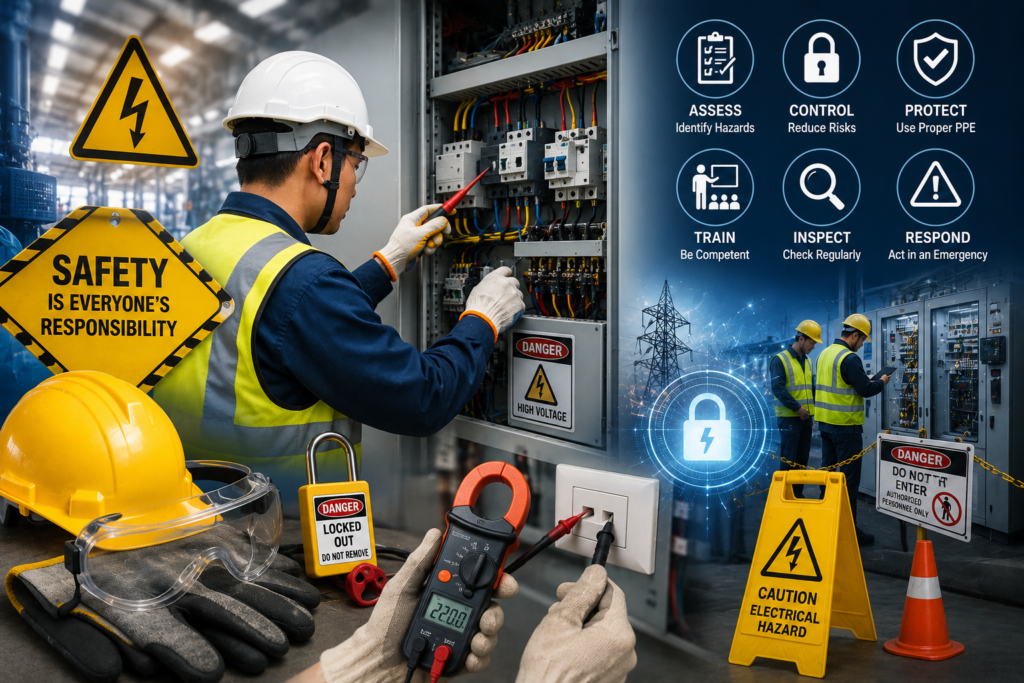
Electricity is a “silent killer” that causes thousands of workplace injuries annually. This program provides essential knowledge on how electricity behaves, the mechanics of electric shock, and the devastating impact of arc flashes. It emphasizes a “safety-first” culture where de-energizing equipment is the default requirement before any work begins.
Electrical Safety Training is an HRDC Claimable programme designed to help employees understand electrical hazards and apply safe working practices in the workplace. Participants will learn how to identify electrical risks, prevent accidents, follow safe work procedures, and implement appropriate safety controls when working with or near electrical systems and equipment.
Course Objectives
This course on Electrical Safety is to expose participant to:
- Comply with OSHA and NFPA regulatory standards.
- Identify common electrical hazards (overloaded circuits, damaged insulation, improper grounding).
- Master the 6-step Lockout/Tagout (LOTO) process to ensure a zero-energy state.
- Standardize the selection and maintenance of Voltage-Rated PPE.
Methodology
- Interactive Theory: Visual presentations using real-world case studies and accident photos.
- Practical Demonstrations: Hands-on practice with LOTO kits (locks, tags, and hasps).
- Hazard Hunting: A walk-through or photo-based exercise to spot electrical violations.
- Assessment: A final knowledge check and practical competency evaluation.
Learning Outcomes
- Zero Accidents: Significant reduction in electrical incidents and “near-misses.”
- Competency: Workers will be able to perform a Risk Assessment before starting any electrical task.
- Preparedness: Staff will know exactly how to respond to an electrical emergency without becoming victims themselves.
- Documentation: Establishes a record of training for corporate safety audits
Who Should Attend
- Authorized Personnel: Electricians, maintenance technicians, and engineers.
- Affected Personnel: Machine operators and assembly line workers who work near electrical equipment.
- Leadership: Safety officers, site supervisors, and facility managers responsible for oversight.
Course Content
Module 1: Electricity Fundamentals & The Body
- The Science of Electricity: Understanding voltage (V), current (I), resistance (R), and Ohm’s Law.
- Path of Least Resistance: How electricity travels in a circuit and its natural tendency to reach the ground.
- Physiological Effects:
- Current Levels: At what milliampere (mA) level the body feels a “tingle” (1mA) vs. muscle contraction (10mA) or heart failure (75mA+).
- Injury Types: Distinguishing between electrical burns, thermal burns, and internal tissue destruction.
Module 2: Hazard Recognition & Analysis
- Common Workplace Hazards:
- Overhead Power Lines: Maintaining at least 10-foot clearance for equipment like ladders or cranes.
- Faulty Equipment: Identifying frayed cords, missing ground pins, and flickering lights.
- Environmental Factors: Hazards of working in wet conditions or confined spaces.
- Arc Flash & Blast:
- Understanding arc flash boundaries and the pressure waves (arc blasts) caused by sudden energy releases.
- Estimating the likelihood and incident energy of an arc flash.
Module 3: Lockout/Tagout (LOTO) Procedures
- Step-by-Step Isolation:
- Preparation: Identify all energy sources (electrical, pneumatic, stored).
- Shutdown: Follow normal stop procedures.
- Isolation: Turn off main power switches/breakers.
- Lock & Tag: Apply physical locks and highly visible warning tags.
- Dissipate Stored Energy: Discharge capacitors or block moving parts.
- Verification (The “Try” Test): Attempting to start the machine to confirm zero energy status.
Module 4: Protective Systems & PPE
- Safety Devices: Functions of Ground Fault Circuit Interrupters (GFCIs), circuit breakers, and fuses.
- PPE Selection & Care:
- Ratings: Selecting arc-rated (AR) clothing and flame-resistant (FR) gear based on hazard levels.
- Specialized Gear: Use of insulated gloves, dielectric boots, and non-conductive hard hats.
- Maintenance: Pre-use inspection for cracks or air leaks in rubber gloves.
Module 5: Emergency Response
- Electric Shock Rescue: How to safely remove a person from a live source using non-conductive materials (e.g., wooden poles) without becoming a victim.
- Electrical Fires: Proper use of Class C (CO2 or dry chemical) extinguishers; never use water.
First Aid: Immediate steps for burns and CPR/AED basics for shock victims