Course Overview
Building Management Control Systems
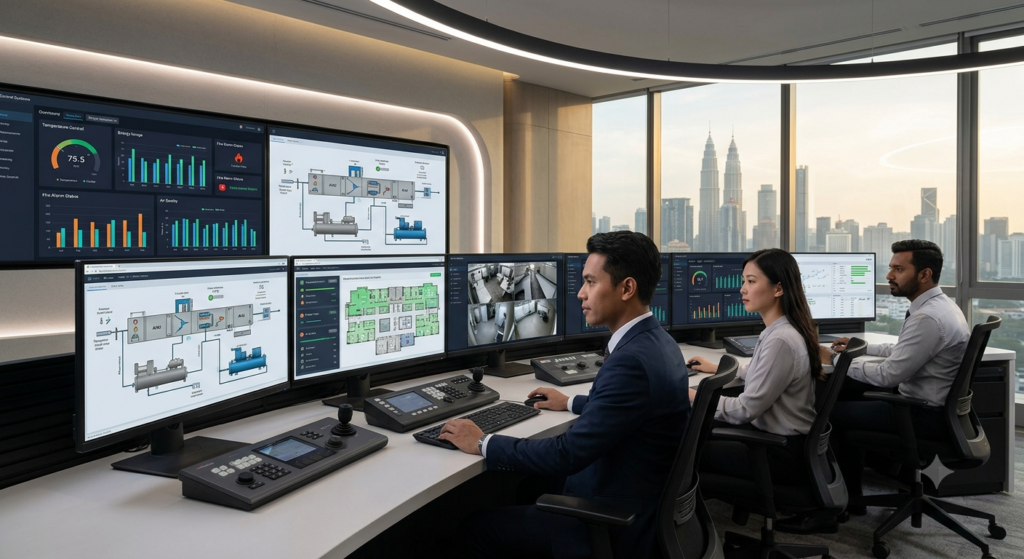
A Building Control System (BCS) is an example of a Distributed control system. Building automation describes the functionality provided by the control system. The control system is a computerized, intelligent network of electronic devices, designed to monitor and control the mechanical and lighting systems in a building.
BAS core functionality keeps the building climate within a specified range, provides lighting based on an occupancy schedule, and monitors system performance and device failures and provides email and/or text notifications to building engineering staff. The BAS functionality reduces building energy and maintenance costs when compared to a non-controlled building. A building controlled by a BAS is often referred to as an intelligent building system.
Building Management System (BMS) is a computer-based control system installed in buildings that controls and monitors the building’s mechanical and electrical equipment such as air handling and cooling plant systems, lighting, power systems, fire systems, and security systems. A BMS consists of software and hardware. The software program, usually configured in a hierarchical manner, can be proprietary using such protocols as C-bus, Profibus, etc. Recently however new vendors are producing BMSs that integrate using Internet protocols and open standards like DeviceNet, SOAP, XML, BACnet, Lon and Modbus.
Learning Outcomes
At the end of the Building Management Control programme, participants will be able to:-
- develop a working knowledge of BAS Systems;
- differentiate between the different types of BAS Systems;
- understand better the design, construction, operations and maintenance requirements of BAS Systems;
- implement strategies and methodologies to create an effective BAS maintenance programme;
- enhance their knowledge and skills to identify and address operational problems at all levels;
- implement mechanisms to measure performance at all levels;
- establish an effective maintenance team.
Course Objectives
The Building Management Control programme, Participants will also be able to:
- Perform BAS Requirement Analysis
- Perform a BCS Analysis (cost estimation)
- Apply Design for Service Principles
- Reduce your company’s costs by analyzing and eliminating the factors that greatly affect the time, cost, and quality
- Utilize effective analysis, brainstorming, and trade-off techniques for redesigning assemblies and subassemblies
Methodology
- The latest educational methods and strategies will be utilized.
- The Building Management Control course is designed to maximize delegate participation.
- Questions and answers are encouraged throughout and at the wrap-up session. This gives participants the opportunity to discuss with others and the presenter their specific problems and appropriate solutions.
- The course shall be conducted through lectures, case studies, group discussions and exercises to reinforce participant’s learning.
Course Format
The Building Management Control course consists of formal content presentation interspersed with content quiz sessions. The presenter’s style involves intensive participant participation.
Who Should Attend
Facilities engineers, maintenance engineers, design engineers, plant engineers, technicians and any one involved in BAS systems and would like to widen their knowledge.
Course Content
Day 1
1. Introduction
- Purpose and Objectives of BCS / BAS
- Applicability of BCS / BAS in Industries
- Topology and Terminology of BCS / BAS Systems
- Building Management Systems in the Current Industrial Environment
2. Infrastructure – Part 1
- Engineered Controllers of BCS / BAS Systems
- Occupancy in Premises Controlled by BCS Systems
- Lighting in Premises Controlled
- Audio & Visual Alarms in Controlled Premises
- Un-manned Security in Controlled Premises
3. Infrastructure – Part 2
- Air handling Units for HVAC Systems
- Constant Volume AHU’s for Normal Human Comfort
- Variable Volume AHU’s for Special Requirements
- VAV Hybrid Systems for Special Applications
4. Infrastructure – Part 3
- Centralized Chiller Plant Systems
- Piped Chilled Water Systems
- Piped Condenser Water Systems
- Hot Water System Generation & Circulation
Day 2
5. Control Engineering
- Computer Engineering Systems & Applications
- Embedded Systems in Engineering
- Process Control Method & Devices
- Digital Control System Applications
6. Control Systems
- Logic Control Systems & SCADA
- On-off Controllers & Sensors
- Linear Control (Open & Closed Loop)
- Proportional Control, Error & Set-Point
- PID Control, Stability & Response
7. Case Study 1
Honeywell Home And Building Control
- Cloud-based solutions
- Intelligent Building Management Systems (BMS)
- Automation Solutions
8. Case Study 2
Johnson Controls
- Verasys system
- Metasys Systems
- Field Equipment Controllers (FECs)
9. Case Study 3
Siemens Building Technologies
- Connectivity & Technologies
- Cybersecurity & Technologies
- Energy & Power Systems