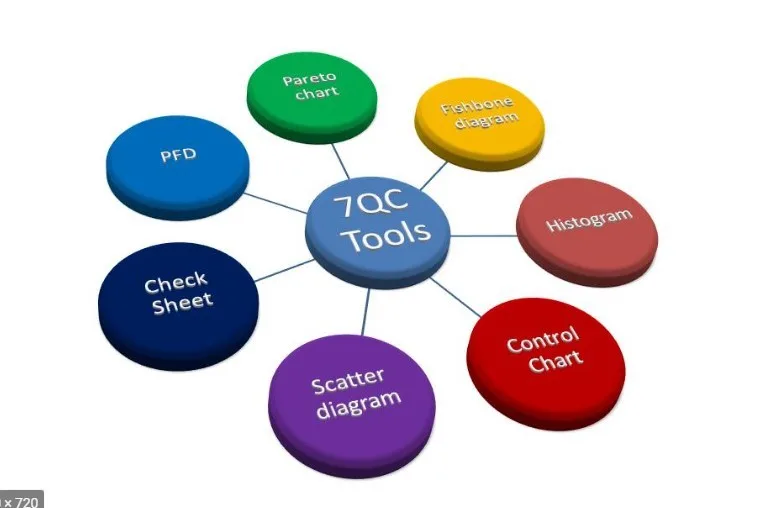
Course Overview for 7QC Tools
Most organizations use quality tools for various purposes related to controlling and assuring quality.
Although a good number of quality tools specific to certain domains, fields and practices are available, some of the quality tools can be used across such domains. These quality tools are quite generic and can be applied to any condition.
There are Seven Basic Quality Tools used in organizations. These tools can provide much information about problems in the organization, assisting in deriving solutions for the same.
By learning the basic tools, organizations can define a structured platform for problem-solving and make Kaizen improvements in their operations. This is the first step towards making a TQM-based organization.
“We make people before making products.” As such, teaching and educating people with the right tools will further enhance the productivity and quality of the service or product provided to customers, and improve the Customer Satisfaction Index.
Learning Outcomes
Upon completion of this programme, participants will be able to:
- Learn the basic concepts, purpose and benefits of 7QC Tools.
- Understand how to use and implement 7QC Tools.
- Examine how to collect and use data for the intended purpose.
- Discover how to use statistics for decision-making.
- Explore the application of 7QC Tools in Kaizen activities.
- Learn how to communicate improvements to the team.
- Anchor improvements as part of the Quality Management System.
Course Content
Module 1: Introduction to Quality and Quality Tools
- Quality and Evolution
- Overview of 7QC Tools
- Benefits of the 7QC Tools
- Definition of Problem
- Kaizen and 7QCC Tools
- People Involvement and Engagement in Problem-Solving / 7QC Tools
Module 2: Introduction to Tools
- Tool #1: Check Sheets
- Gather Information & Data
- Process Mapping to Get Clarity of the Problem
- Use Data Collection Plan to Gather Data to Support Decision-Making
- Class Exercise
- Tool #2: Pareto Diagrams
- Class Exercise with Case Study
Module 3: Fishbone and Why-Why Analysis
- Tool #3: Fishbone Diagram
- Class Exercise
- Tool #4: Why-Why Analysis / Action Formation
- Class Exercise with Case Study
Module 4: Flow Chart and Application
- Tool #5: Flow Chart and the Use of It
- Flow Chart Steps
- Real Project Review and Application
- Questions & Answers
Module 5: Variable & Attribute Control Charts
- Review and Recap of Tools Studied
- Tool #6: Control Chart and Application (Variable / Attribute)
- Class Exercise and Case Study
- Summary
Module 6: Scatter or Relationship Diagram
- Tool #7: Scatter Diagrams
Class Exercise with Case Study